Prototype:
Overview:
Worldwide, an estimated 700 million people will experience a disabling level of hearing loss by 2050 (World Health Organization, 2026). Traditionally, doorbells notify users through sound. As such, this becomes an obstacle for those who are unable to hear. A multitude of generalized smart doorbells solve half of the problem; for example, Ring doorbells propose a way to notify users without sound, but it requires the Ring application (Ring, 2026). This alienates users who do not want app-based systems, are less comfortable with smartphones, or do not want to constantly check notifications. Despite the prevalence of hearing loss in the population as a whole, the number of different assistive doorbell designs for the hard of hearing or deaf remains minuscule. Current commercialized versions aiming to confront the problem of hearing problems utilize a light-emitting diode (LED) receiver that flashes brightly whenever the doorbell is activated (ADCO Hearing Products, 2026). This means that if the user is asleep, in another room, outside, or simply not facing the receiver, the alert may be missed. Some studies, such as one by Paidi et al. in 2022, have suggested the use of a wearable device equipped with LEDs in order to make it more likely to be seen by the user, but current prototypes are bulky and get in the way of daily movement, as well as still may fail to alert someone if they are not looking at it. As such, the proposed device will aim to improve on these shortcomings, allowing for users to have an easier time knowing when a doorbell is pressed.
Problem Statement:
Our client, Client A, is hard of hearing, and does not notice when someone arrives at her apartment door. Therefore both family, friends and service workers cannot easily communicate with the client. Current technology, which rely on sound, visual alerts, or smartphone notifications, is unreliable and insufficient at solving this problem (The Business Research Company, 2026).
Engineering Objective:
The objective of this project was to design and test an assistive doorbell that wirelessly and soundlessly notifies the homeowner of a visitor using a vibration motor inside a small, wearable wrist-device.
Design Approach:
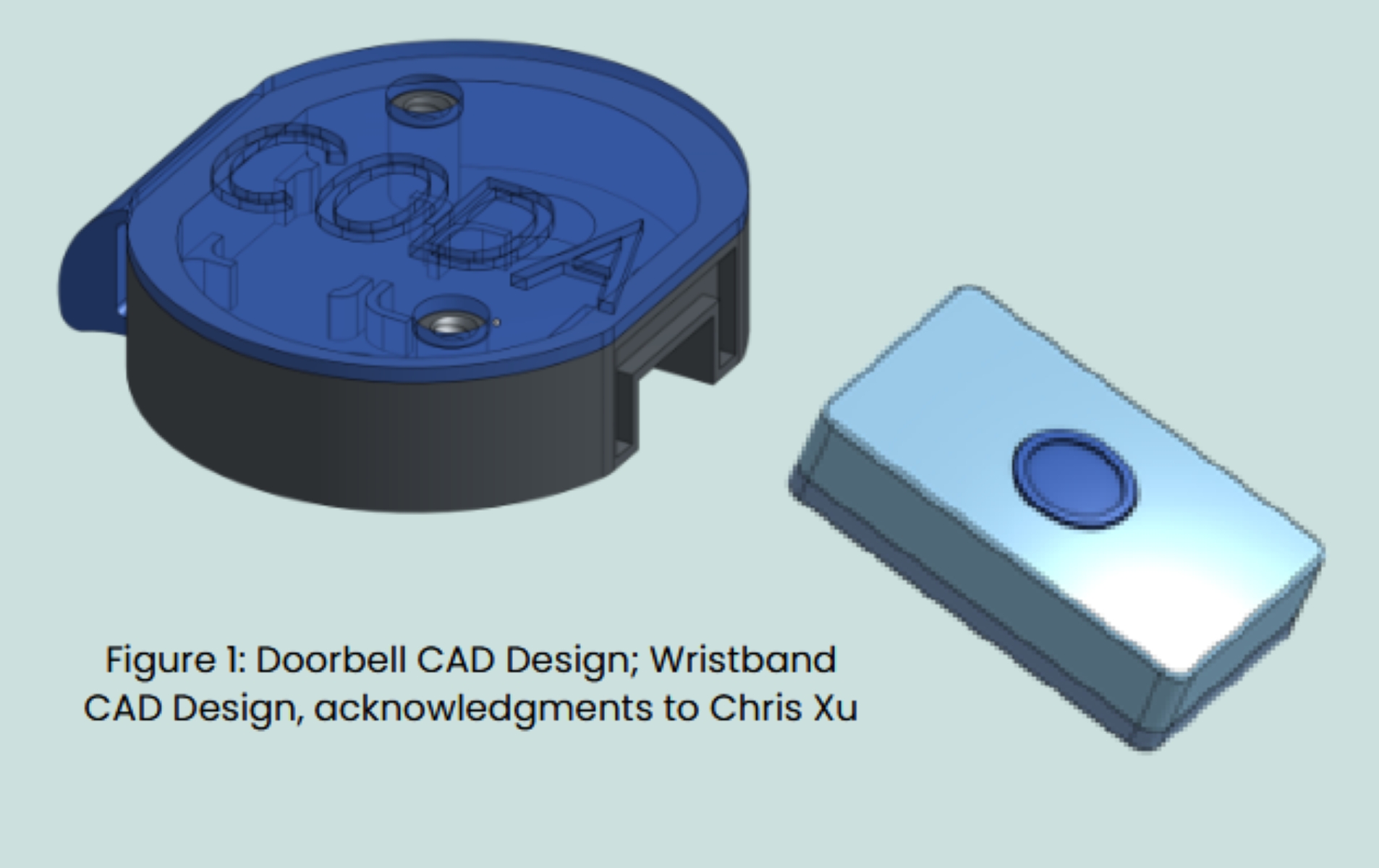
1. Design and construct 2 different casings: the doorbell and the wrist device.
2. Get two nRF52840 boards and connect them to each other using the Bluetooth functionality
3. Add a button to one nRF board, and a vibration motor to the other.
4. Put the electronics in each of their respective casings, then ensure functionality!
Prototype:
AT Project Poster:
AT Handout: