Computer Science
The Computer Science class at Mass Academy includes a lot of lessons, followed by application. We learn the coding processes, methods and tools, and then put
them to use through an assignment, project, or creation that we can actually use (like this website!).
Assignments

This assignment involved using the AWT graphics methods in java code to create the image that you see on the right. It was both fun and challenging, and
involved some math tricks as well as learning the properties of the java methods. If you'd like to view the code for this assignment, click the text labeled
"Line Art Code". Line Art Code
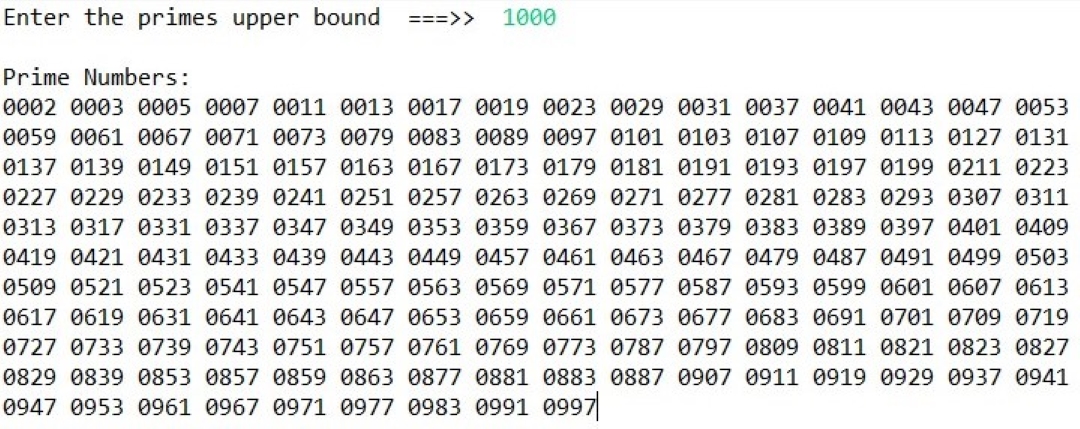
This assignment involved using arrays and loops to create a program that generated all the prime numbers from 0 to any given number (which could be inputed by )
the user). This program was designed using the principals within the Sieve of Eratosthenes, an ancient algorithm with the purpose of creating a more efficient way
of finding prime numbers. We then also had to format the program exactly as you see on the left. If you'd like to view the code for this assignment, click the text
labeled "Sieve of Eratosthenes Code". Sieve of Eratosthenes Code
Apps for Good
Apps for Good was a group project with the goal of developing a native or web application with the purpose of addressing a specific goal or need. I worked with Aishani
Gosh and Naaisha Agarwal, and our app was called CityCiv *click to view app*.
Problem:
The problem we discovered originated from our concern with local politics and the fact that all of us were mostly unaware and un-involved. When we considered this,
we realized that no one really taught us what to do or how to be involved with your community's civics. To confirm this, we emailed the Mayor's office in Worcester,
Massachusetts, our local city. The Assistant Chief of Staff responded and verified our concern, that they have a large lack of civic engagement from teens and young
adults, even in matters that involved largely affected them such as education and driving policies.
Solution:
We decided to create a web-app (that could also be downloaded onto the device if desired) to serve as a community platform, teaching tool, and a resource for citizens
of Worcester.
Target Audience:
Like mentioned before, our target audience was teens and young adults that are unaware of how to be involved in their community and/or local civics. Our goal was to get
this age group of citizens to be more engaged in Civics.
MVP:
Our Minimum Viable Product (MVP) was our Community Dashboard feature. This feature allows users to communicate and interact with each other, ranging from citizens making
posts, to government officials. The posts can contain anything ranging from governmental conventions, to a community party.
Other Features:
The app also includes multiple other pages. One is the Learn page, where users can learn about what our app is and how to use it, as well as different civics related vocabulary,
informational resources, and civis lessons. Another page is the Town Meetings page, where users can view future, and past community meetings about topics of interest. Lastly is
the account page which simply allows the user to change some key information such as username.
Two more features include complete sign in and account management functionality using an online data base called SupaBase, and also a download app feature that stores the application
directly on the device.