STEM II, like STEM I, is taught by Dr. Crowthers. In STEM II, small groups of 4-5 work on an assistive technology product to help clients in the community. This class is entirely focused on the engineering process, from ideation to prototyping to testing.
SmartStep: An Engineered Cane Design with Obstacle Detection and User Feedback Systems for the Visually Impaired
Ryan Prendergast, Sam Wheatley, Richard Yan, Emmanuel Yu
Problem Statement
Of the seven million visually impaired Americans, there is an estimate of less than ten percent of this population using white canes as a visual aid tool. Certain practical downsides contribute to driving visually impaired individuals away from cane use. Namely, this issue involves the white cane’s limited range combined with the fact that the cane has to make physical contact with an object before providing information to the user. To address this, the device involves a detection and user feedback system to increase the range of the cane, remove its dependence on making physical contact, and relay this information to the user before an obstacle is hit.
Design Approach
Our design approach began with brainstorming different forms for object detection and user feedback systems.
With three possible Arduino positions, detection methods, cane tips, and feedback types, there were 81
possible configurations to test in initial prototyping.
After our design studies, a cane with sonar object detection and haptic vibration motor were deemed the
strongest candidates for future testing. Fusion360 was used to design a cane shaft with the capability
to house all hardware and wiring, and feedback was collected from a client who provided our group, Team
S'moRRE, with invaluable comments through her experience as a visually impaired person. After continued
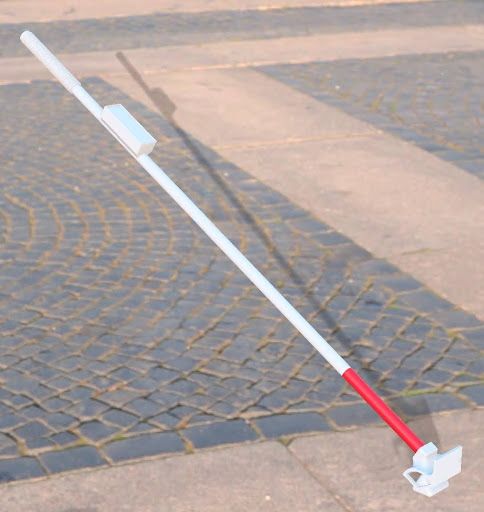
redesigning and improvements, our final design can be seen below!
Prototypes
Prototype version 4 of SmartStep involves remote object detection up to one meter away and haptic user feedback. With a tested accuracy greater than ninety-five percent, the cane comes with an adjustable three base tip that can provide different movement surfaces depending on the environment and terrain. The design has been prototyped to be lightweight, weighing 0.45kg, and more durable than previous designs by withstanding up to eighty Newtons of pressure along its shaft.