Computer Science is taught by Mrs. Taricco. In Computer Science, students first learn how to build design and build their own websites using HTML and CSS. Students then learn important Java concepts such as object-oriented programming, algorithms, control structures, data structures, and logic. Students who have shown a strong understanding in Java are able to bypass the Java curriculum and conduct their own Independent Computer Science Project, where they research a new skill or language and apply it in an area of their interest.
Independent Computer Science Project
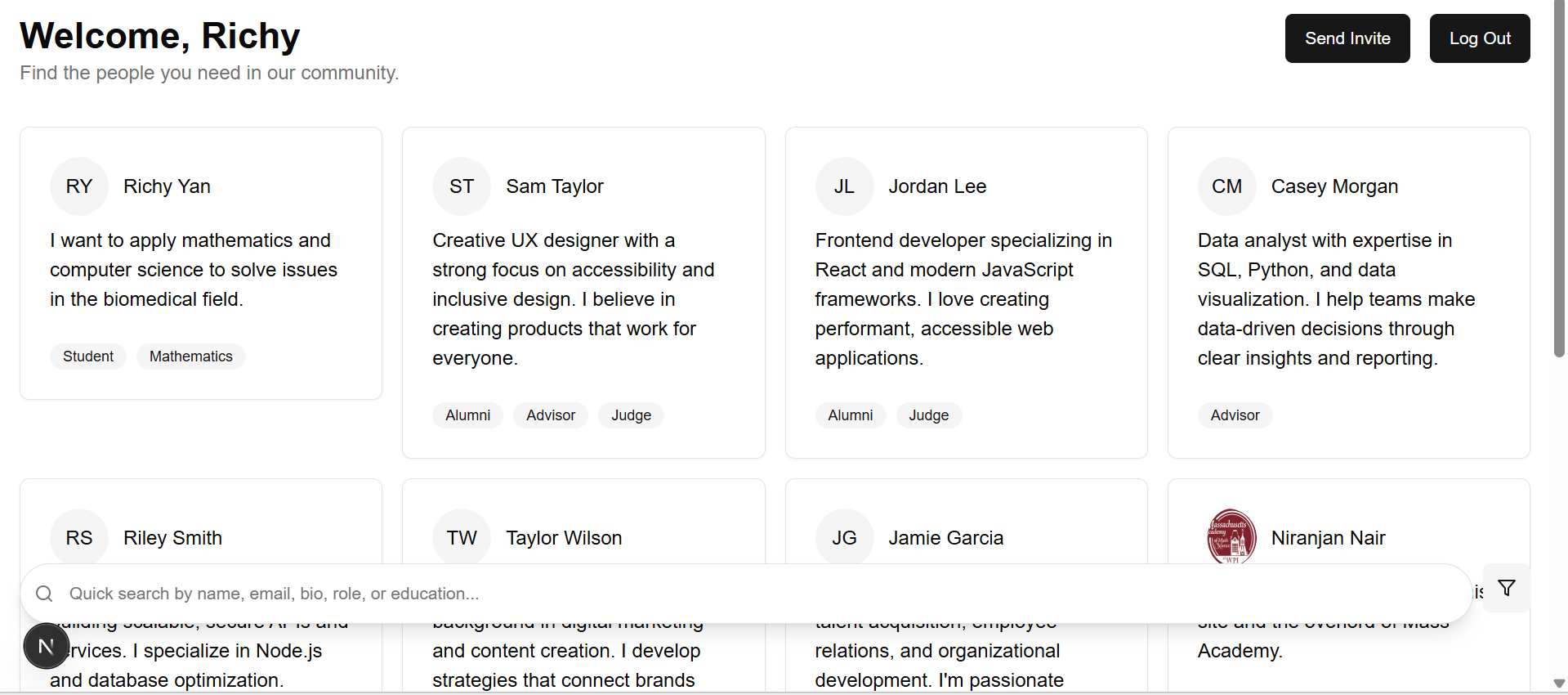
My Independent CS Project is a website and database that allows students to connect with alumni for advice, mentorship, internship opportunities, and more. I mainly used React, Next.js, and Firebase for this project. Below is what the main page of the website looks like.
PrimeSum
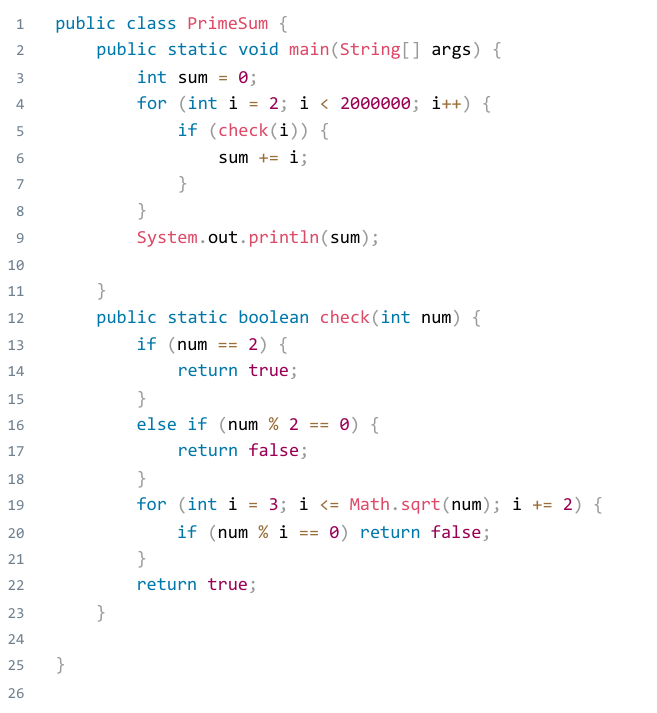
Before I started my Independent CS Project, I was first assigned 10 Java problems for practice. My favorite problem was the problem where we had to find the sum of all the primes up to a certain number. You can find the implementation below.
Apps for Good
Problem Statement
Academic paralysis, the inability to begin or sustain productive work due to mental health and emotional obstacles, is a growing issue amongst both high school and college students. Unlike ordinary procrastination, where a conscious choice is involved in the delaying of a task, academic paralysis is when a student wants to act but feels stuck. Typically there are 3 main reasons for this: perfectionism, task overwhelm and executive function gaps (SOS4Students, 2025). Perfectionism and task overwhelm increase internal and external pressures on the student causing them to freeze when confronted with an important assignment. The stress and anxiety induced by these divert cognitive resources, impairing the brain’s executive function, or its ability to plan, organize, prioritize and initiate tasks (Wick, 2025). Executive dysfunctions can manifest as difficulty motivating oneself to start a task that seems difficult or uninteresting, trouble planning out or carrying out a task because one cannot visualize the finalized product or goal and struggling to move from one task to another (Papa, 2023).
The scale of this problem amongst students is alarming. Approximately 80% of college students are estimated to procrastinate (González-Brignardello et al., 2023), making it a largely severe challenge in the education system.
The consequences of untreated academic paralysis are both serious and far-reaching. It negatively impacts academic achievements and self-confidence, eventually leading to more college dropouts, delays in meeting deadlines and a lack of motivation. Even more concerningly, mental health issues were the third most cited reason for leaving college amongst students who dropped out (Marken, 2024). Students are largely left without targeted, personalized support tools to identify why they are stuck and what specifically to do about it.
Target Audience
Our app design focuses primarily on high school and college students, a demographic that research consistently identifies as among the most affected by academic paralysis and procrastination. According to Wick (2025), task paralysis is especially prevalent during transitions into adulthood, when external structures decrease and students are expected to independently manage time and self-motivate. Our app specifically targets individuals that find themselves “stuck” and unable to complete an assignment due to factors such as anxiety, ADHD, depression and perfectionism. These students often don’t know that they are stuck or why they are stuck, and more importantly what mitigation strategies would help them in that moment. By creating a system that helps students reflect and identifies the specific cause of their paralysis, our app bridges a gap in student support enabling them to take back control of their academics.
Solution
Our application addresses academic paralysis by providing high school and college students with a diagnostic app that identifies the specific type of paralysis they're experiencing and generates a personalized intervention plan to overcome it. As students continue using the app, it learns from their behavior to deliver increasingly tailored support.
Minimal Viable Product
For our minimal viable product, our app will:
Have a button saying “I’m Stuck", that users can easily access when they are feeling academically paralyzed.
Have a questionnaire that can be accessed by pressing the “I’m Stuck” Button. It will contain questions that will help us get some context on the user’s situation. Responses will be analyzed using a Sentence-BERT word embedding model and logistic regression model to output stuck type and probability. This info will be used to generate personalized follow-up questions, helping determine the reason for the user’s academic paralysis.
Generate an intervention plan for the user by feeding the Sentence-BERT’s and logistic regression results to an OpenRouter API key to generate an intervention plan tailored to their needs.