STEM I

Summary

STEM I is taught by Dr. Crowthers. Students learn how to effectively pull information from research articles, conduct their own research, and write research proposals. The biggest part of STEM I is the independent research process, where students conduct research on a topic they’re very interested in. In December, there is the December Fair that displays a student’s preliminary data. In February, there is the February Fair in WPI. Students who do well are sent to WRSEF, MSEF, and sometimes even ISEF .

Overview

Antibiotic resistance is a growing global health crisis, with millions of deaths annually and limited treatment options. Bacteriophage therapy offers a promising alternative, but the complex interactions between phages, bacteria, and antibiotics are not well understood. This research addresses critical gaps in current approaches by developing an integrated mathematical model that combines computational simulations with experimental validation to predict population dynamics under combined treatment scenarios. Results show that combining phages with antibiotics leads to oscillations in bacterial populations, while phages alone eliminate bacterial populations and antibiotics alone lead to a rise in resistant bacteria levels.

ABSTRACT

Antibiotic resistance is one of the biggest health threats right now, with 1.27 million people being directly killed by it in 2019. While bacteriophage therapy has emerged as an alternative to antibiotics, the dynamics between phages, bacteria, and antibiotics remain poorly understood. Current research often suffers significant limitations: math models often lack experimental validation, and empirical phage studies don’t provide a quantitative and predictive framework. This project addresses these gaps by developing an integrated computational-experimental approach to create a mathematical model and validate it. We propose to create this mathematical model using ordinary differential equations to simulate the population dynamics of both susceptible and resistant bacteria when being pressured by both the phages and antibiotics. The model will be implemented in both a deterministic and stochastic framework, and parameter values for E. coli and T7-like phages will be taken from literature. The model will later be validated through experimental testing which will find the population of susceptible and resistant bacteria after a week in vitro with phages and antibiotics. This research represents a shift from traditional single-disciplinary approaches toward an integrated approach that combines both mathematical rigor and biological experimentation.

Graphical ABSTRACT
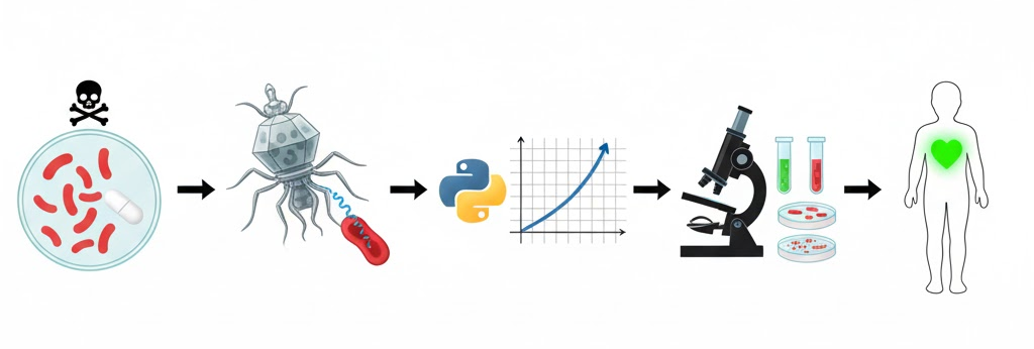
Visual Abstract

Research Proposal

Research Question

How do bacteriophages influence bacterial populations under antibiotic pressure?

Hypothesis

Bacteriophages will reduce bacterial populations under antibiotic treatment, but resistance will persist due to phage-mediated transduction spreading antibiotic resistance genes.

Visual Intro

Background

Methodology Infographic

Visual Methodology

Methodology

Figures and Analysis

Discussion

Conclusions

References

February Fair Poster