In Advanced Computer Science, we further our understanding of programming by developing a programming project that excites us and allows us to gain expereince developing a complete coding project and also learn new coding skills. The class started with HTML and CSS which allowed us to develop this personal website. Then, we moved on to Java, where we learned the fundamentals of programming. The content of this part of the class closely follows the AP Computer Science A curriculum. Finally, we will develop the Apps For Good project, where we work in groups to make an app that will help people.
Binary Counting
We worked on these challenge problems in the beginning of the year. This problem was called Binary Counting. It was a practice American Computer Science League (ACSL) problem. The goal was to take a string of a sentence and convert each character to its ASCII value and then change that to a complete binary string of each ASCII value. From there, there are a series of manipulations to do to the binary string to get to the final output number. The embedded pdf is the instructions for the challenge and this is the code
Trouble viewing the PDF? Click here
Independent Computer Science Project
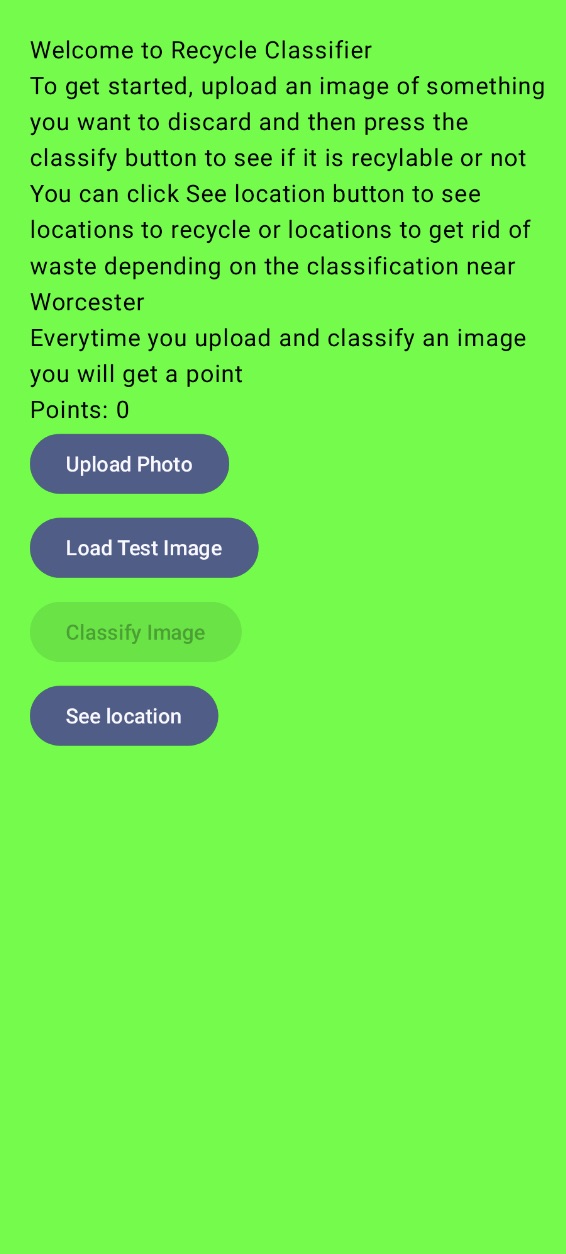
In this project, we were able to choose any computer science related project that we wanted to develop and work on. I chose to develop an app that can help users identify whether they should recycle or trash their item. I wanted to help people recycle who wanted to recycle but were unsure of what bin to recycle their item in. For this project there were 3 parts. First, I had to develop the model and train it on the dataset I got from Kaggle. Then I had to develop that app user interface. Finally, I had to connect the model to the app. My final source code is on github. On the left, there is an image of what the app looks like. If you download and clone the github repository, you can access the full source code for this project.
Apps for Good
Problem: Despite being more connected than ever, teenagers and young adults are increasingly
disconnected from their local communities (Belle Booth, 2025). This is especially evident in the
fact that only about 10% of young adults vote in local elections (Valentine, 2024). However, this
group wants to engage with their community, as demonstrated by surveys and attempts to do so, though these efforts have been inconsistent and informal (Pollard, 2026). Teenagers and young adults who want to engage with their local community and government but don’t know how have expressed a need for a platform designed for them that makes local community and civic engagement easy and enjoyable (Searles, 2026). Current platforms aren’t locally focused,
making it hard to find events, or don’t help increase civic engagement.
Target Audience: In line with our main problem, our project is aimed at teens and young adults aged 16 to 25. This is because adults and senior citizens are disproportionately represented in their town’s civic life through town meetings and board meetings (V Ganesan, personal communication, February 20, 2026). The importance of voting has declined over the
years, and its importance has been lost on the young people of today. Specifically, we are
targeting the young residents of our local town, Worcester, Massachusetts. Our app aims to
rekindle civic engagement in this age group and make it both accessible and fun for young users.
Solution: CityCiv is a new app that connects people in local communities, increases civic engagement, and fosters connections with local government, designed specifically for teenagers and young adults. Its main feature is a Community Dashboard that enables users to easily discover local events, share ideas, and actively participate in their local community in real time. CityCiv redefines connection, fostering connection in local communities and making civic engagement a part of daily life.
Problem: Despite being more connected than ever, teenagers and young adults are increasingly
disconnected from their local communities (Belle Booth, 2025). This is especially evident in the
fact that only about 10% of young adults vote in local elections (Valentine, 2024). However, this
group wants to engage with their community, as demonstrated by surveys and attempts to do so, though these efforts have been inconsistent and informal (Pollard, 2026). Teenagers and young adults who want to engage with their local community and government but don’t know how have expressed a need for a platform designed for them that makes local community and civic engagement easy and enjoyable (Searles, 2026). Current platforms aren’t locally focused,
making it hard to find events, or don’t help increase civic engagement.
Most Viable Product: To foster a sense of community and solve our core problem, our MVP is a Community Dashboard featuring events that residents have posted and responded to, as well as questions or posts where local residents can interact with each other. Because of this, the two main features will be an interactive dashboard for all local events in the town that residents post to and react to, and the ability to communicate with each other.
Process: The process of developing this application required researching the problem and identifying similar apps. As part of our research, we conducted outreach to several local government officials to learn more about the problem. After understanding the problem, we developed flowcharts and screen page plans. From there, we started development. We utilized GitHub to manage our code amongst ourselves. The website was developed primarily with HTML, CSS, and JavaScript. We additionally added persistent data using Supabase integration, added authentication, turned it into a PWA, and deployed it for anyone on the internet using Vercel.
You can try our app yourself here!
Having trouble viewing the poster? Click here.