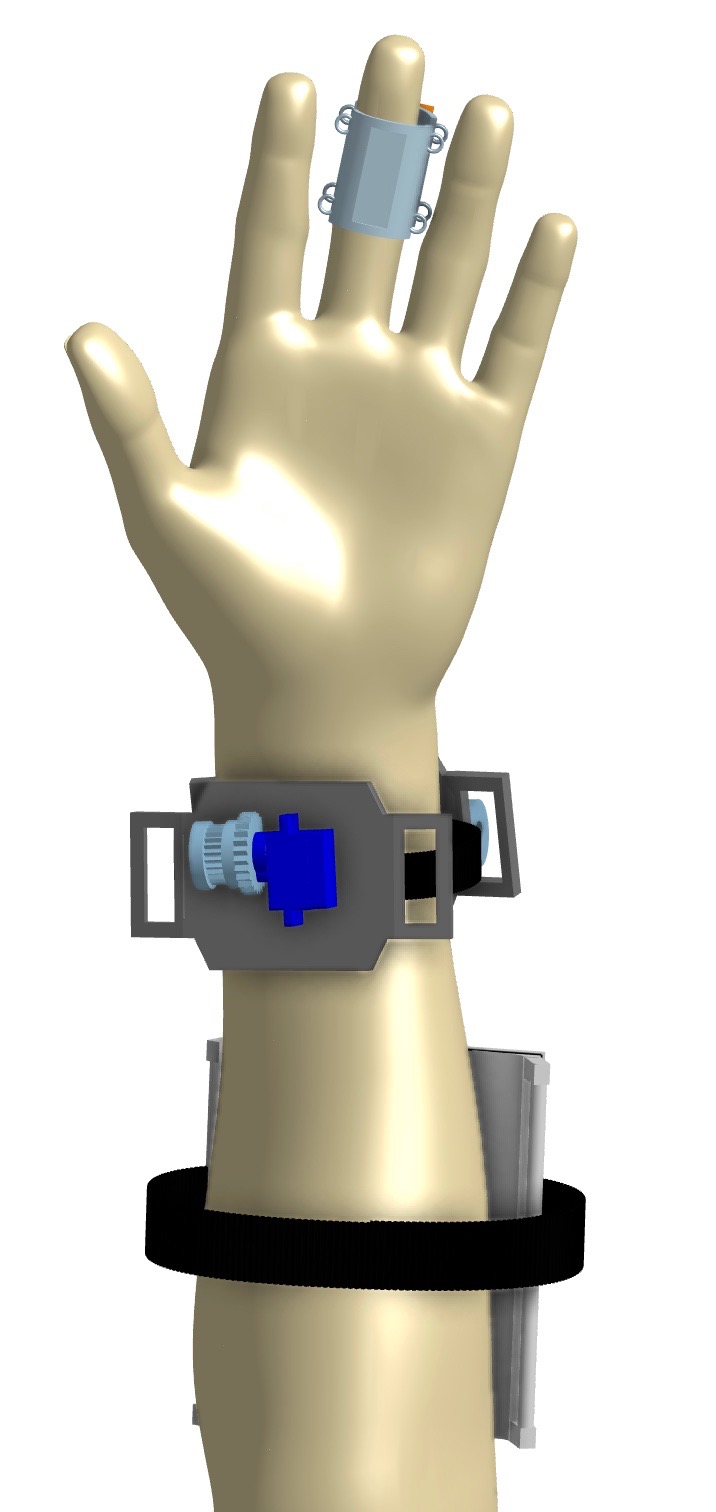
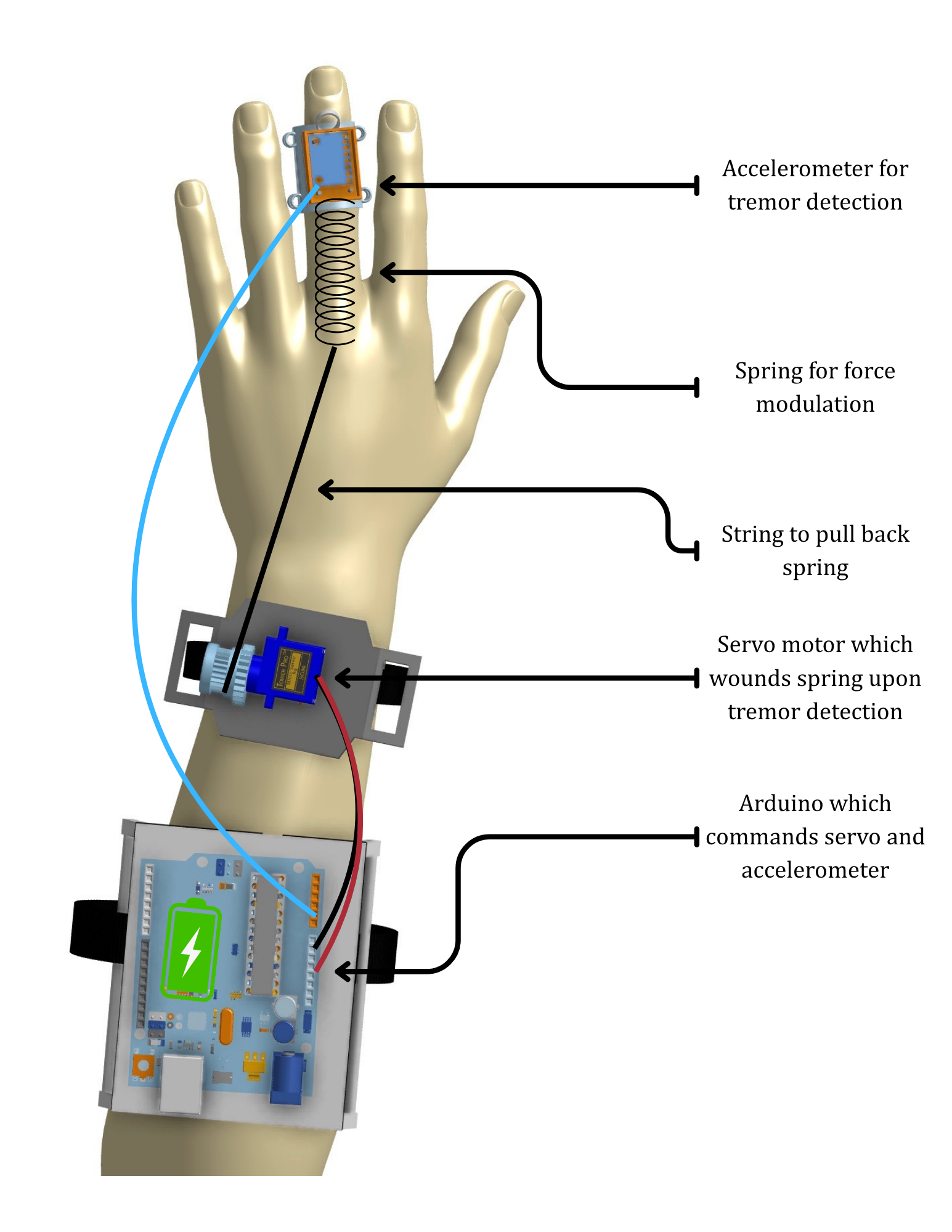
Patients suffering from neuro-degenerative diseases, especially ALS but including MS and Parkinsons as well, often suffer from finger tremors that reduce grip-ability and comfort. The engineering objective of this project is to develop an affordable, accessible device that suppresses finger tremors using mechanical methods. The final design, titled DigiGuard incorporated a spring to function as a dampening force on finger movement, which was attached to the end of the finger alongside an accelerometer to detect tremor motion. The spring was wound back upon detected tremors with a servo motor connected to an armheld arduino, slightly pulling back the finger and ultimately found to reduce tremors in simulatory environments by up to 84%.
One in four hundred Americans are diagnosed with ALS during their lifetime. ALS, Amyotrophic Lateral Sclerosis, is a fatal disease that cripples the motor neuron, weakening the mind’s connection to its muscles. This disease causes muscle atrophy, pain, and weakness and is progressive, meaning that symptoms worsen over time. Currently, there is no medication or treatment which can stop or reverse the progression of ALS. Rather, a combination of newly engineered drugs and assistive technologies, such as lifts and ventilators, can prolong survival and lessen the burden of the disease. Symptoms in ALS usually start with the hands, mouth or feet. These symptoms are small yet persistent, and escalate over time. Specifically, they are manifested with tremors– uncontrollable consistent oscillations in the finger, hand, foot, or similar muscle. Fasciculations, which are spontaneous involuntary contractions of motor units that present as random twitching and are often mistaken for tremor, are considered a pathophysiological hallmark of ALS and frequently precede the onset of muscle weakness . Early symptoms in the face and throat include a weakened voice and throat, often requiring the use of assistive technology to breathe safely without pain. General muscle weakness itself is classified as an early symptom and is easily identified by a reduction in normal physical ability and endurance. As the disease progresses, the symptoms worsen and typically spread locally. For example, someone whose symptoms may have begun in their feet will usually suffer weakness in their throat and voice much later on. All ALS patients become bedridden and result in a semi-paralyzed state after a longer time with the disease as symptoms spread to the entire body. A disease with 100% fatality, ALS does more to the body than impairing limbic motion and causing a bedridden state. First of all, most ALS associated deaths are the result of respiratory failure, on two accounts. The first, ALS weakens the lungs directly and without certain technologies such as a ventilator the lungs fail and the body dies. Secondly, and perhaps more common, the use of these assistive devices and the weakness of the lungs can increase the risk and degree of consequence from infections. This causes sicknesses ranging small colds to pneumonia to have devastating effects. As of today, these risks are mitigated through proper care techniques, sanitation of devices and equipment being used. The lifespan of ALS patients on average is 2-5 years, although the median has grown in recent years as a result of newer medications and stronger care. The other often unaccounted impact ALS has on PALS (People with ALS) is the mental burden a loss of independence and a life of pain can bring. As symptoms worsen in ALS patients, they can no longer care for their personal needs and need assistance with personal and menial tasks: changing clothes, eating and drinking, using the restroom, hygiene, and even entertainment such as playing games or trying to read a book. Assistive technologies such as deep transfer learning-empowered wearables have been developed to help ALS patients communicate even as motor function declines. Despite these innovations, the loss of independence can feel humiliating and forces the patient into a state of survival rather than the ability to strive for any personal purpose–the patient can no longer work or assist their family in the same way. Moreover, living with ALS is very painful. Because the muscles are rapidly atrophying but the nerves remain strongly connected to the brain, the patient can feel the effects of muscular death: cramps, weakness, and sores. Joints are neglected from a lack of motion and exhibit immense pain as well, especially when forced to correct their position. As the patient is driven into a painful and dependent state, restoring aspects of self-independence and alleviating day-to-day pains becomes critical to their wellbeing. Many PALS report simple tasks such as walking, keeping balance, lifting small objects (cups, computers, etc.), and getting up and into a seated position to be consistently challenging while also posing risks, such as falling or smacking into a hard surface. Assistive technology is therefore developed to restore independence and alleviate symptoms. A variety of technology is available to patients based on their personal needs, these include lifts, wheelchairs, specialized utensils, and other devices. One emerging assistive technology is the development of tremor-suppression wearable devices which reduce limbic tremors in patients suffering from any tremor-associated disease. While these primarily include Parkinson's and MS patients, PALS are equally affected by tremors and have need for these devices as well. Tremor suppression is done either by adjusting general hand motion to sync with tremors or using an external force to reduce the amplitude of tremors (such as applying weight to each finger in the case of finger tremors). Tremor suppressive devices classically target the entire hand or limb which suffers from tremors, and offer little precision. Additionally, many tremor suppressive devices are expensive and unavailable to many patients who are looking for an easy and accessible solution to their persistent symptoms. Finger-specific tremor suppression remains an underexplored niche, as most wearable devices are designed for the broader hand or wrist and cannot isolate individual digit motion. As the number of PALS grows year by year, as longevity is sustained through emerging medicine and technology, combating even the most minute of symptoms becomes critical when evaluating the total health and well-being of patients. A component of hand weakness and tremors, finger weakness and tremors profoundly impact a number of ALS patients, as well as those of Parkinson’s and MS, and may not be prevented with the technology that is available to restore full hand/wrist motion. Therefore to both restore independence in patients and develop a more accessible and precise tool to combat ALS symptoms, a tremor-suppressive device focused purely on finger movement, which impacts many day-to-day activities, may be developed. The proposed device would both revivify hand motion and overall day-to-day wellbeing while tactfully demonstrating the use of precision and simplicity as the basis of a new and more accessible assistive technology.
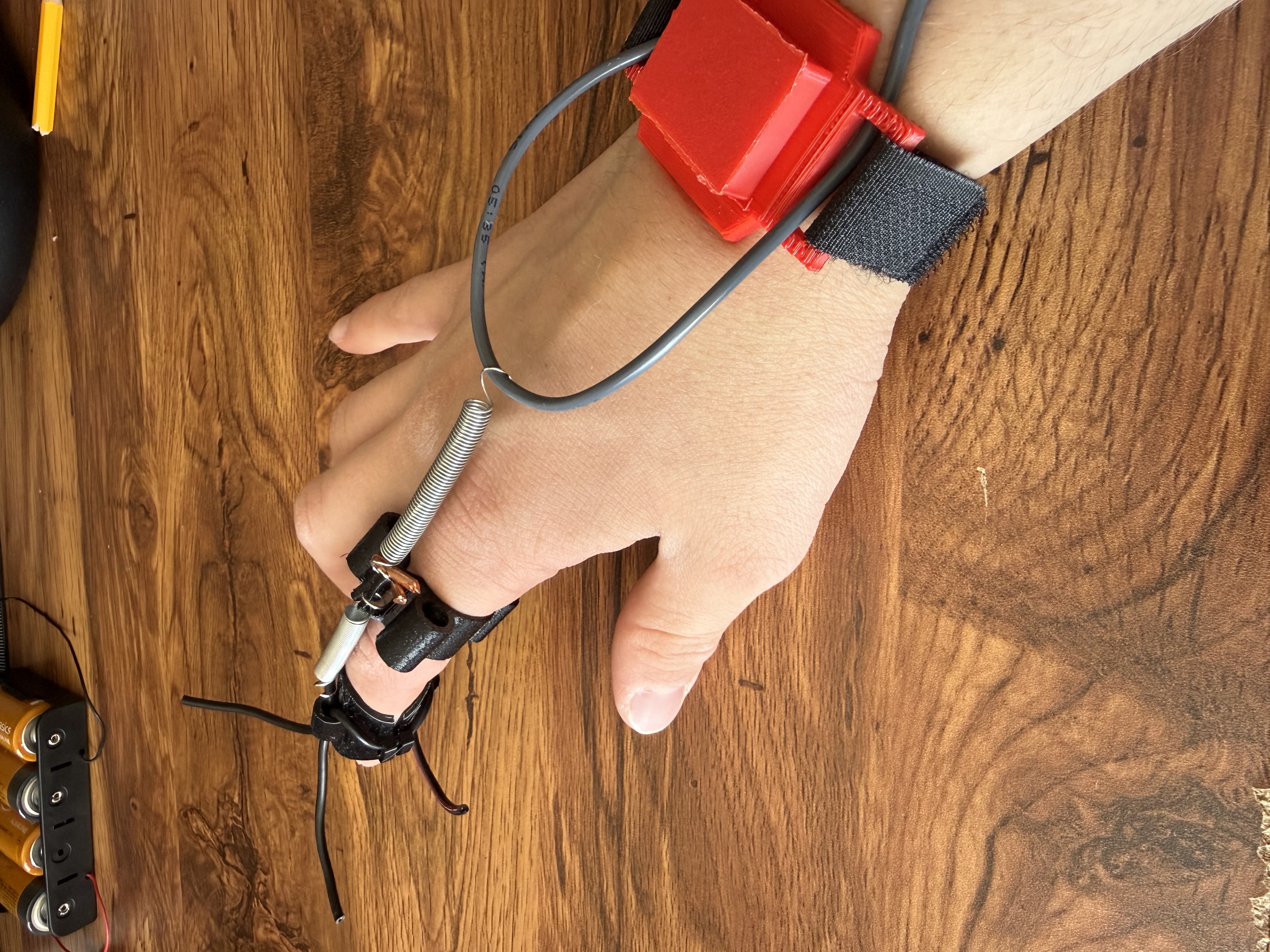
The initial design was a purely mechanical prototype, using a spring connecting the wrist and the finger to constantly apply dampening force. This iteration was restrictive and did not detect tremors
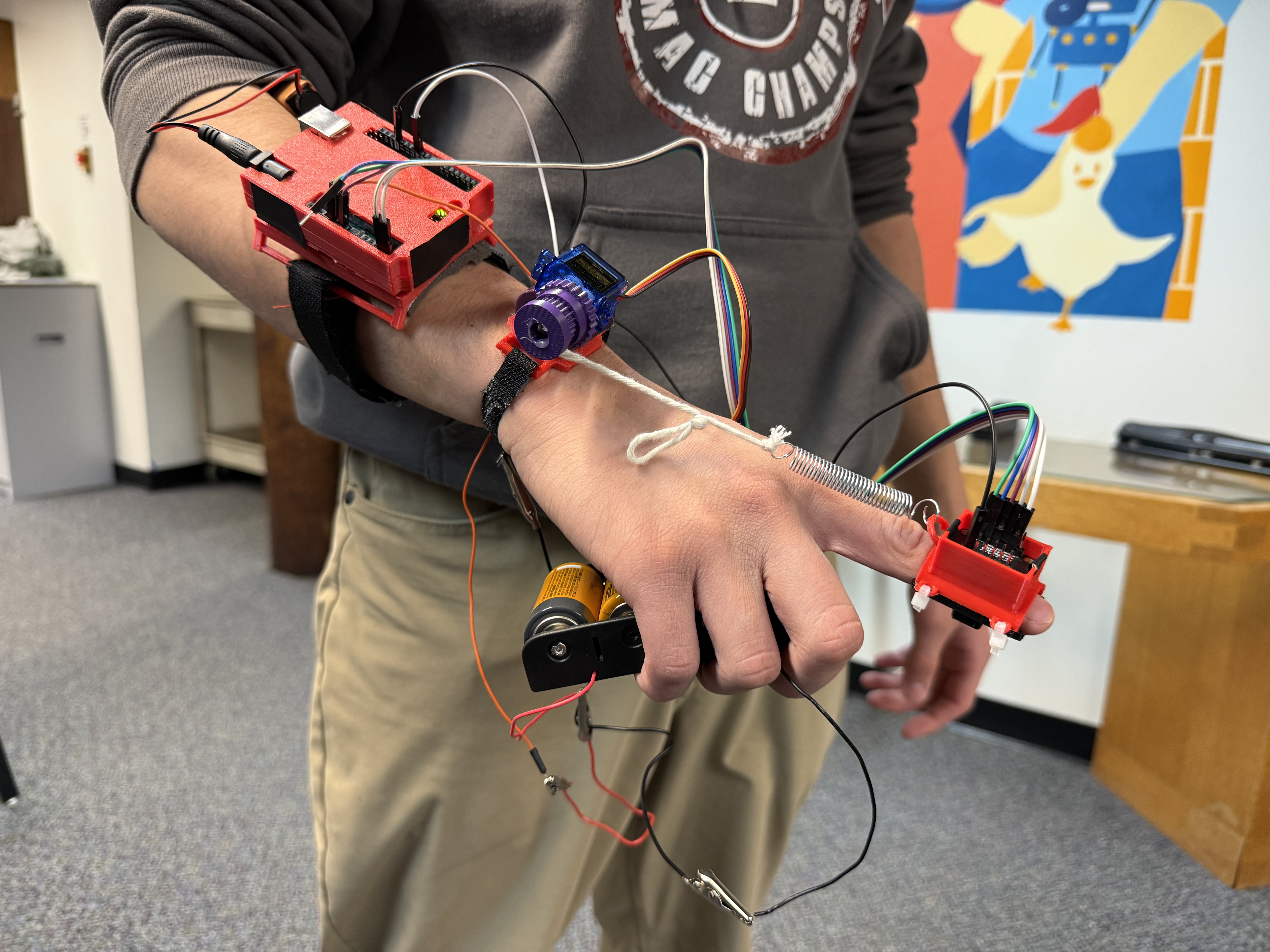
The second design uses a servo to now pull back the spring upon tremor motion. An engineering matrix was used to settle this as the final design
The third design was an addition to the second design, where it matched the top servo with a servo below the wrist and replaced the springs with cords.