Analyzing the Effects of Fluid-Integrated Outsoles on Foot Swelling
Overview
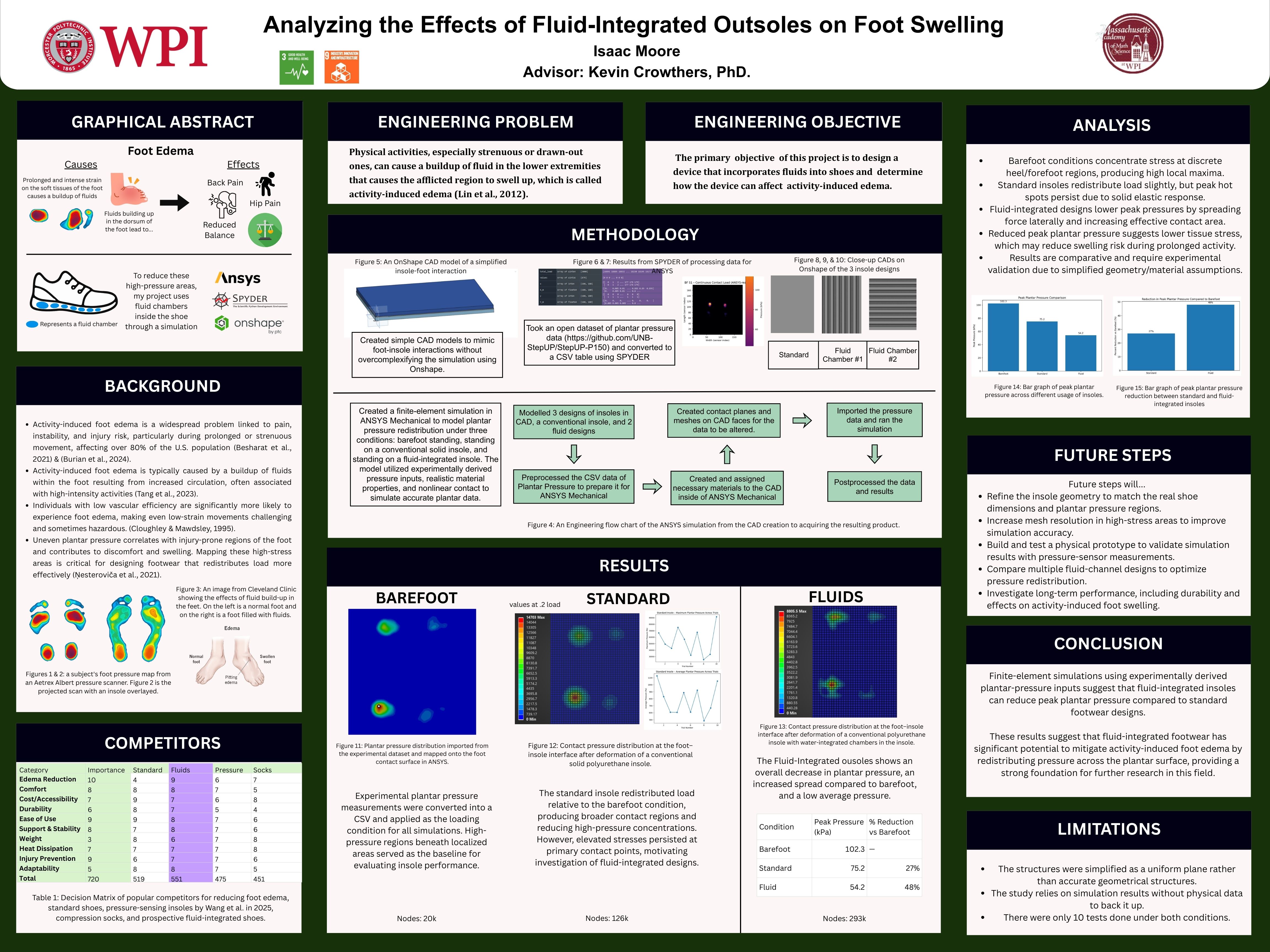
In this project, a simulation was conducted to analyze the effects of fluid-integrated shoes on plantar pressure redistribution. By reducing high-pressure regions along the plantar surface of the foot, the simulation demonstrated the feasibility of water-based integration as a method for mitigating foot edema.
Abstract
Foot swelling, or edema, is a common physiological response to strenuous or prolonged physical activities. The swelling is caused by excess fluids from the body accumulating in the feet, leading to discomfort, reduced stability, and an increased risk of injury. Individuals with reduced vascular efficiency, such as older adults, people with obesity, or those with circulatory challenges, are especially prone to the risks of foot edema, making daily activities challenging and potentially dangerous. To address this problem, this project assesses how integrating fluid chambers into everyday shoes can reduce activity-induced foot edema by redistributing the pressure along the plantar surface of the foot. The buildup of fluids in the foot is a direct effect of increased stress on the foot, so by redistributing the pressure of high-pressure areas on the foot, the need for these fluids is reduced. By utilizing ANSYS, a leading company in developing engineering simulation software, a simulation was developed to assess the theoretical possibility of using fluids to redistribute the force exerted onto the foot to even out the high-pressure areas. The simulation results indicate reduced pressure in high-impact areas, spreading the force towards the middle of the foot. These findings assisted in determining the feasibility and structures of fluid chambers within the shoe, suggesting overall, the fluid-based shoe systems have the potential to reduce foot strain and mitigate foot edema. If validated through physical testing, this concept could improve comfort and safety during everyday activities, particularly to populations more prone to foot edema.
Graphical Abstract
Phrase 1
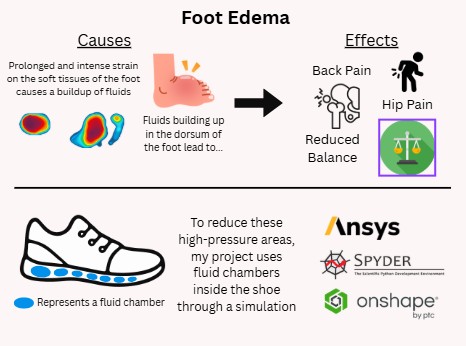
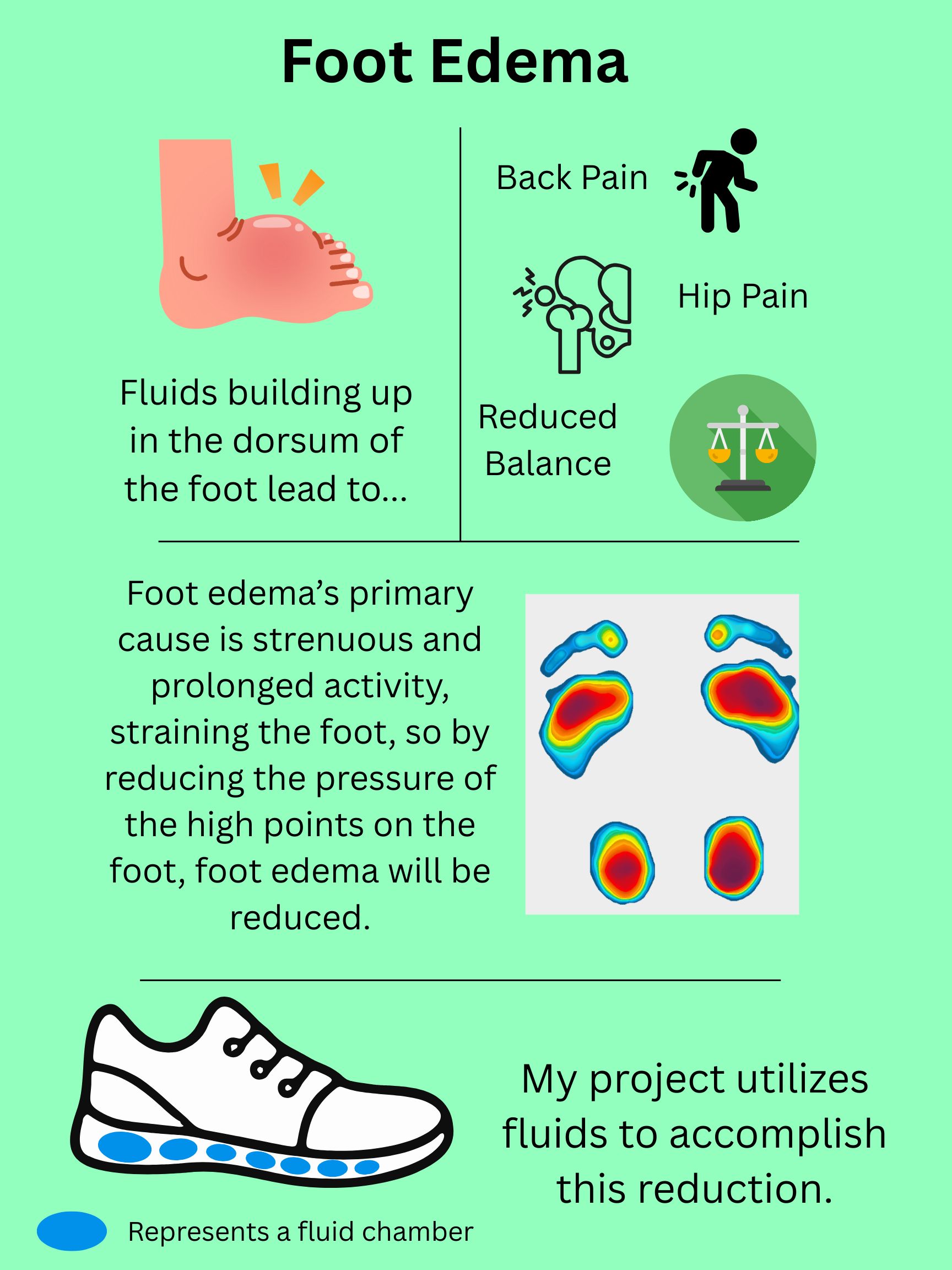
Physical activities, especially strenuous or drawn-out ones, can cause a buildup of fluid in the lower extremities that causes the afflicted region to swell up, which is called activity-induced edema (Lin et al., 2012).
Phrase 2
The primary objective of this project is to design a device that incorporates fluids into shoes and determine how the device can affect activity-induced edema.
Background Infographic
Background
Project Description The primary objective of this project is to design a device that incorporates fluids into everyday shoes and determine how the device can affect activity-induced foot edema. Using ANSYS simulations, the theoretical effectiveness of fluid-integration will be assessed, and then the optimal layout of fluid chambers will be decided. Once the layout of chambers is finalized, a prototyped design will be created and tested. While wearing fluid-integrated shoes, participants will engage in standing, walking, jogging, and sprinting activities. The practical effectiveness and comfort of the shoes will then be evaluated by measuring the foot edema caused by the activity using the water displacement method (King, 1993) and asking subjective questions to the participants after the activity. The results of the test will then be compared to the results of similar tests using standard shoes to determine whether the integration of fluids into shoes can reduce foot edema and improve comfort in daily activities. Background and Significance While mild foot edema is commonly observed among most individuals, severe occurrences are typically seen among people who have decreased vascular efficiency within their bodies, such as people who are older, overweight, or have circulatory problems (Cloughley & Mawdsley, 1995). In the United States, this statistic is particularly concerning because the rising obesity rates are shown to be closely related to foot edema (Burian et al., 2024), with one study showing that approximately 80% of individuals with obesity suffer from some form of edema, ranging from mild, harmless swelling to chronic foot edema, which means their swelling is long-term rather than temporary (Keast et al., 2014). As a result, people with vascular deficiencies are more prone to injuries and discomfort from everyday activities such as standing and walking. These negative effects highlight the need for strategies to mitigate foot edema. Plantar Pressure Foot edema is caused by a buildup of fluids in the foot, which, in most cases, is caused by prolonged activities that cause certain areas in the foot to receive a higher-pressure load than others, causing more tissue strain. This pressure system along the bottom of the foot at any given time is called plantar pressure. It is commonly uneven, with the highest pressure typically occurring under the heel and the ball of the foot.
Procedure
Procedure
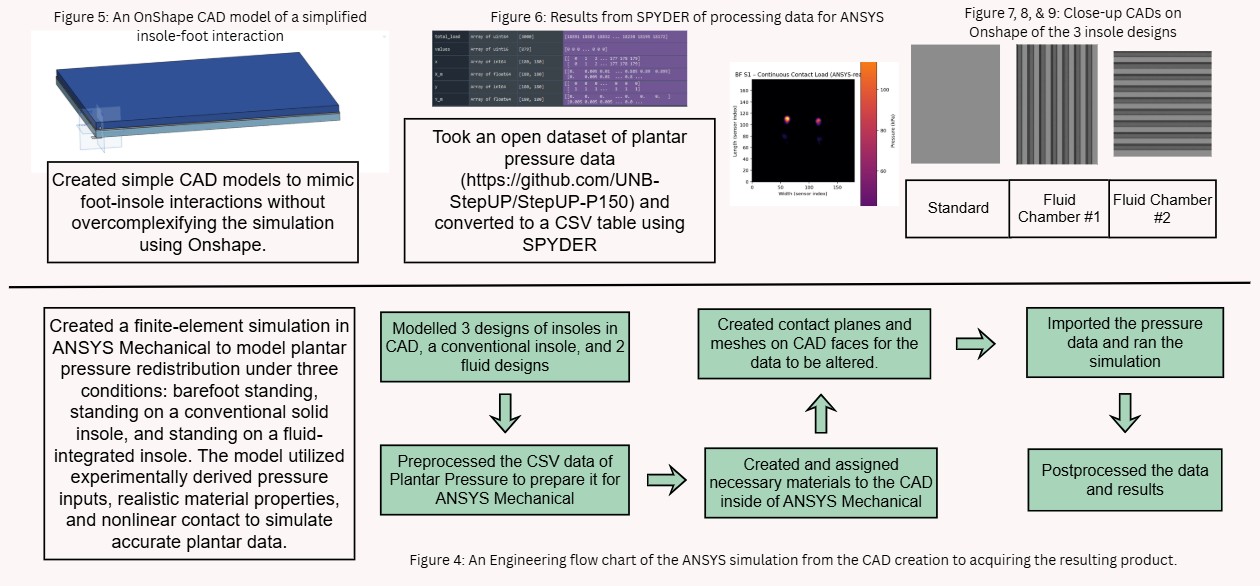
Equipment and Materials All computer aided designs were made using Onshape, which was used to develop simplified insole and foot designs to reduce the complexity of the simulation. Finite-element simulations were conducted in ANSYS Mechanical (Student Edition 2025 R2) to model foot–insole contact interactions, material deformation, and plantar pressure redistribution. The insoles were assigned polyurethane materials to simulate the deformation of realistic insoles, and the foot was developed as a rigid model for controlling the pressure load. Plantar pressure inputs were obtained from an open-access dataset published on GitHub (UNB StepUP/StepUP-P150), which contains spatial plantar pressure distributions recorded during standing and gait. These data were converted into comma-separated value (CSV) format using Python in the SPYDER IDE development environment to enable import into ANSYS as spatially varying pressure fields. Post-processing and data visualization were completed using ANSYS built-in tools, including the Contact Tool and Tabular Data export features. Technique 1: Finite-Element Modeling of Foot-Insole Interaction Using ANSYS Mechanical (Student Edition 2025 R2), a finite-element modeling of foot-insole interactions was conducted to assess the feasibility of fluid-integrated footwear in reducing activity-induced edema. This technique was selected because it allowed for the selection of specific materials, controlled evaluations of pressure systems, and the integration of fluids inside of the shoe. This technique required developing the CAD models in Onshape, transferring the CAD models to ANSYS, and creating and assigning materials to prepare the models for the simulation. Then, with the models ready, the CSV of plantar pressure data was applied to the top face of the foot geometry, which was then projected down onto the insole, which was then solved to give the simulated redistribution of plantar pressure after contacting the insole while standing. Statistical Tests
Figure #1
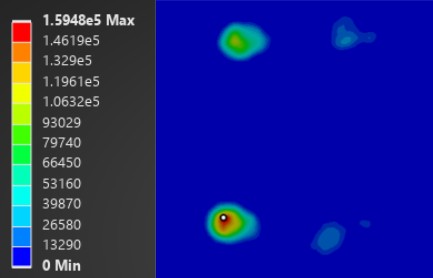
Plantar pressure distribution imported from the experimental dataset and mapped onto the foot contact surface in ANSYS.
Figure #2
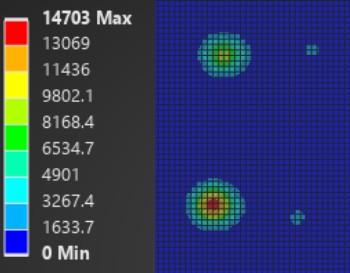
Figure 11: Contact pressure distribution at the foot–insole interface after deformation of a conventional solid polyurethane insole.
Analysis
Barefoot conditions concentrate stress at discrete heel and forefoot regions, producing high local pressure maxima. Standard insoles redistribute load slightly, but localized pressure concentrations persist due to the uniform elastic response of solid materials. Fluid-integrated designs reduce peak pressures by redistributing force laterally and increasing the effective contact area, which lowers localized tissue stress and may decrease swelling risk during prolonged activity. However, these findings are comparative and require experimental validation because of the simplified geometry and material assumptions used in the simulation.
Discussion/Conclusions
Finite-element simulations using experimentally derived plantar-pressure inputs suggest that fluid-integrated insoles can reduce peak plantar pressure compared to standard footwear designs.
These results suggest that fluid-integrated footwear has significant potential to mitigate activity-induced foot edema by redistributing pressure across the plantar surface, providing a strong foundation for further research in this field.
References
ANSYS, Inc. (1970). Ansys® Mechanical (Release R2). ANSYS, Inc.
Besharat, S., Grol-Prokopczyk, H., Gao, S., Feng, C., Akwaa, F., & Gewandter, J. S. (2021). Peripheral edema: A common and persistent health problem for older Americans. PLoS ONE, 16(12), e0260742. https://doi.org/10.1371/journal.pone.0260742
Burian, E. A., Rungby, J., Karlsmark, T., Nørregaard, S., Cestari, M., Franks, P. J., & Moffatt, C. J. (2024). The impact of obesity on chronic oedema/lymphoedema of the leg—An international multicenter cross-sectional study (LIMPRINT). International Journal of Obesity, 48(9), 1238–1247. https://doi.org/10.1038/s41366-024-01544-0
Cleveland Clinic. (2026, February 9). Edema. https://my.clevelandclinic.org/health/diseases/12564-edema
Cloughley, W. B., & Mawdsley, R. H. (1995). Effect of running on volume of the foot and ankle. Journal of Orthopaedic and Sports Physical Therapy, 22(4), 151–154. https://doi.org/10.2519/jospt.1995.22.4.151
Myfeet.com. (n.d.). https://myfeet.com/
Ņesteroviča, D., Stepens, A., & Vaivads, N. (2021). Peak plantar pressure as a risk factor for lower extremity overuse injury among infantry soldiers. Proceedings of the Latvian Academy of Sciences Section B: Natural, Exact, and Applied Sciences, 75(1), 52–57. https://doi.org/10.2478/prolas-2021-0009
Tang, Y., Guo, X., Zhou, T., Li, L., Gao, J., Wang, Y., Huang, L., & Wei, S. (2023). Effects of shoelace tightness on lower limb biomechanics and subjective perception during lateral shuffle in basketball. Acta of Bioengineering and Biomechanics, 25(4). https://doi.org/10.37190/abb-02400-2024-02
Wang, C., Lei, P., Sheng, H., Bi, H., Hu, J., Guo, C., Mao, Y., Yuan, J., Shao, M., Jin, Z., Li, J., & Lan, W. (2025). A wireless, self-powered smart insole for gait monitoring and recognition via nonlinear synergistic pressure sensing. Science Advances, 11(16). https://doi.org/10.1126/sciadv.adu1598
Feb Fair Poster