HemoLimb
A vibration compression sleeve for hemovisualization-related psychogenic paresthesia, designed by Parnitha Karapakula, Aishani Ghosh, Adrika Moulik, and Saara Patel. Advised by Dr. Kevin Crowthers at the Massachusetts Academy of Math and Science, May 2026.
The Problem
Our client experiences hemovisualization-related psychogenic paresthesia: when he hears or thinks about blood, his arm goes numb and he loses the ability to write. This happens during biology class and can last up to 15 minutes. About 20% of children and adolescents experience some form of psychogenic paresthesia.
Current coping strategies like fist-clenching require active effort and do not meaningfully speed up recovery. Research shows vibration therapy can restore circulation and reduce numbness by stimulating blood flow and dampening the vasovagal response.
Our Solution
HemoLimb is a wearable compression sleeve embedded with vibration motors at anatomically targeted pressure points: the extensor muscles, the radial artery, and the palm. The client presses a button to start a vibration cycle (15 seconds on, 10 seconds off), and the device runs until arm function is fully restored.
In testing, it brought the client from near-zero mobility to full arm function in under 5 minutes, compared to 9+ minutes without the device.
Preliminary Designs
We built and tested three prototypes before arriving at the final device.
Prototype 1: Vibration Compression Sleeve
Motors at the extensor muscles, palm, and radial artery in warm fleece fabric. Vibration placement worked well, but the fleece absorbed sweat and became uncomfortable. All later prototypes used a sleek, cool fabric.
Prototype 2: Targeted Nerve Vibration Sleeve
A slim wristband with one motor aimed at the superficial radial nerve. Discreet and comfortable, but targeting only the wrist was insufficient for the full-arm weakness the client experiences.
Prototype 3: Step-Motor Compression Sleeve
A step motor tightened the sleeve in 15-second intervals to apply compressive pressure. After testing, vibration was clearly more effective, compression alone did not produce fast enough recovery.
All three designs were evaluated in an engineering matrix across 14 weighted criteria. The Vibration Compression Sleeve scored 86.3%, outperforming the targeted nerve sleeve (82.4%) and the step-motor sleeve (81.9%).
Final Prototype
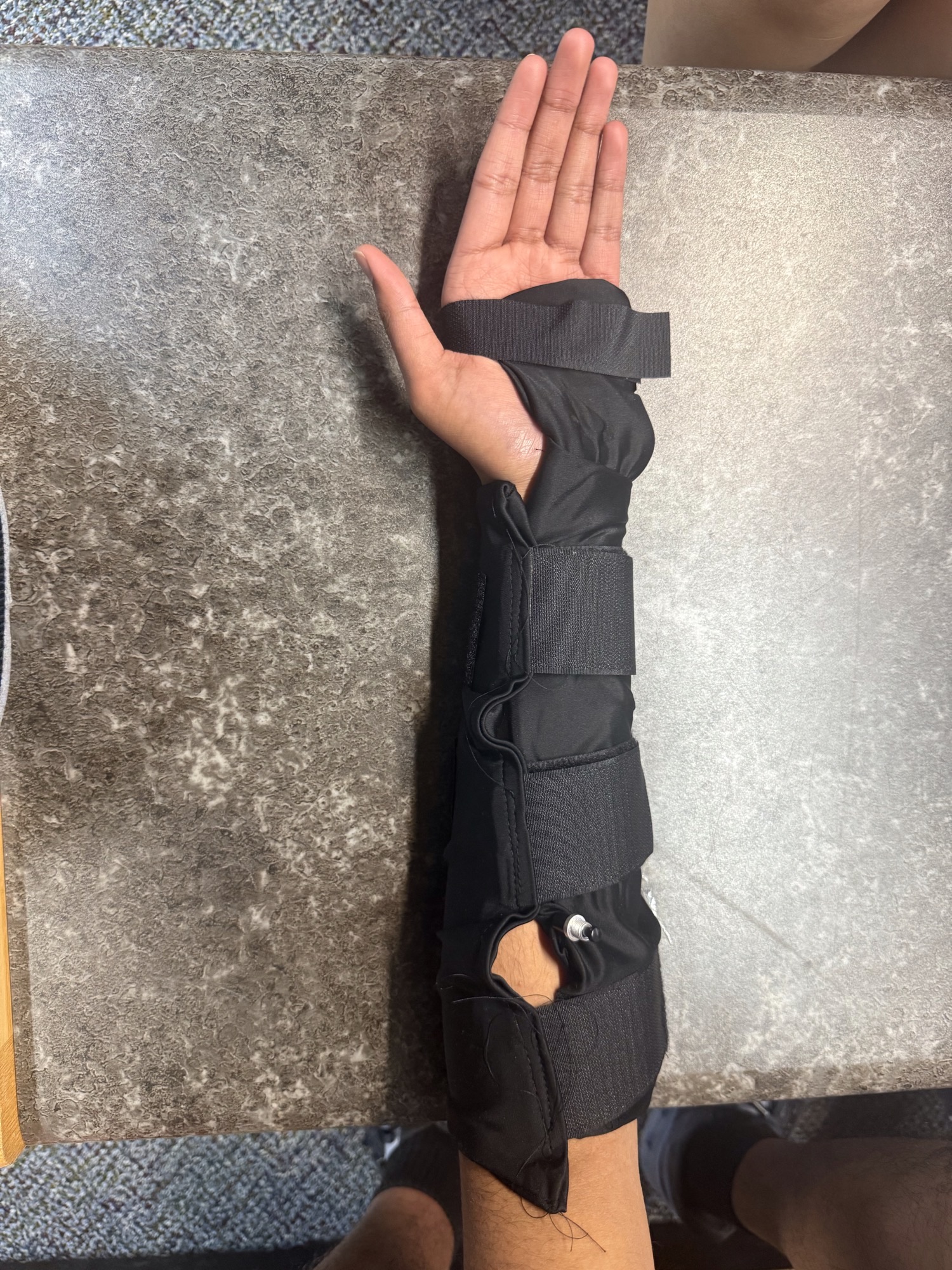
The final HemoLimb is built from lightweight black spandex with three vibration motors in sewn fabric pockets. The sleeve wraps from wrist to just below the elbow, fastened with velcro sized to the client's arm. A 9V battery and push button sit at the inner elbow. All internal components are hidden from view. A separate palm pad allows hand stimulation without restricting movement. The client can write, type, and hold objects while wearing it.
Design Studies
Temperature Over Time
We tested whether the device meets the L1 criterion of not overheating during use. Using a GoTemp Vernier probe in direct contact with the motor across three full cycles, temperature rose from 27.16°C to 46.8°C at a rate of 0.06°C/second, below our 50°C safety threshold. In actual use, the motor is separated from skin by fabric, so real exposure is even lower. HemoLimb passed the L1 thermal safety criterion.
Arm Weakness Over Time
Our client rated arm weakness on a 1–10 scale (10 = no movement, 1 = full function) every 25 seconds across a 300-second episode, once with and once without the device. Without HemoLimb, weakness improved from 9 to 6. With HemoLimb, it went from 9 to 1, full recovery, in the same time. The device's recovery slope was nearly three times steeper. HemoLimb passed both L1 criteria.
Comfortability Survey
Multiple test subjects wore HemoLimb and rated ease of arm movement from 1–10. Most ratings fell between 8.4 and 9.1, indicating minimal restriction in normal arm movement. HemoLimb passed the L2 criterion for full range of motion during non-episode use.
Full Design Study
Unable to view? Open PDF
Future Work
The next version of HemoLimb will replace the push button with an Arduino so vibration cycles run automatically without input from the client during an episode. After that, we plan to add a microphone and OpenAI Whisper audio recognition so the device activates on its own when it detects the word "blood", making the device fully passive. The same system could be reconfigured for other clients with different trigger words.