Procedure Graphic
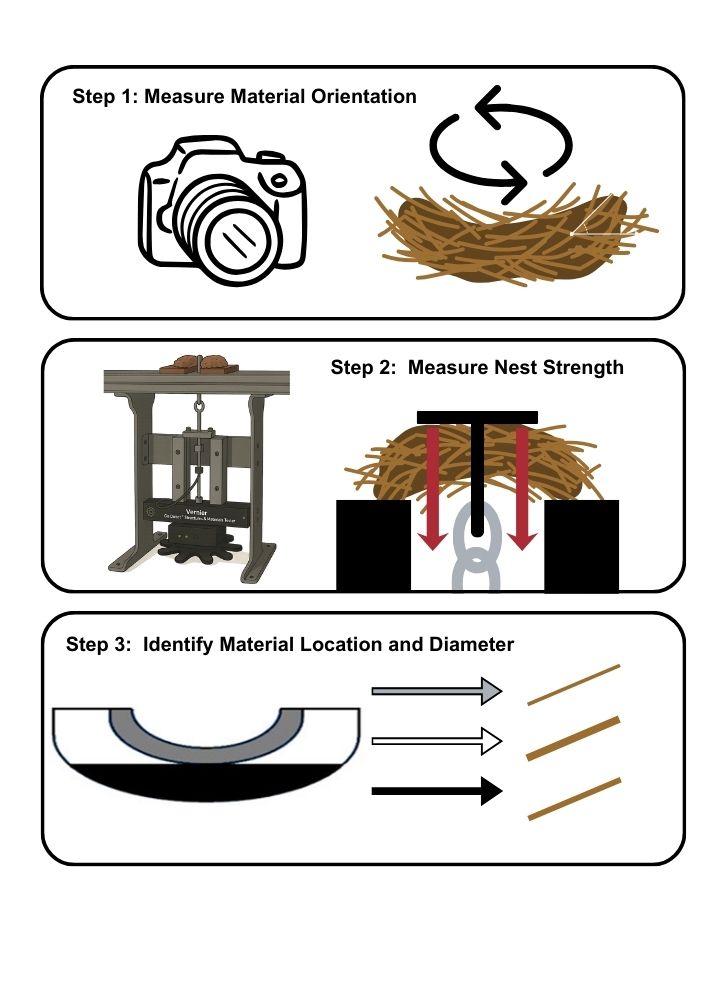
The above picture is a visual representation of the steps I took to complete this project.
Procedure
Part 0- Acquiring Nests: I acquired nests from members of the Northborough-Southborough community in late October.
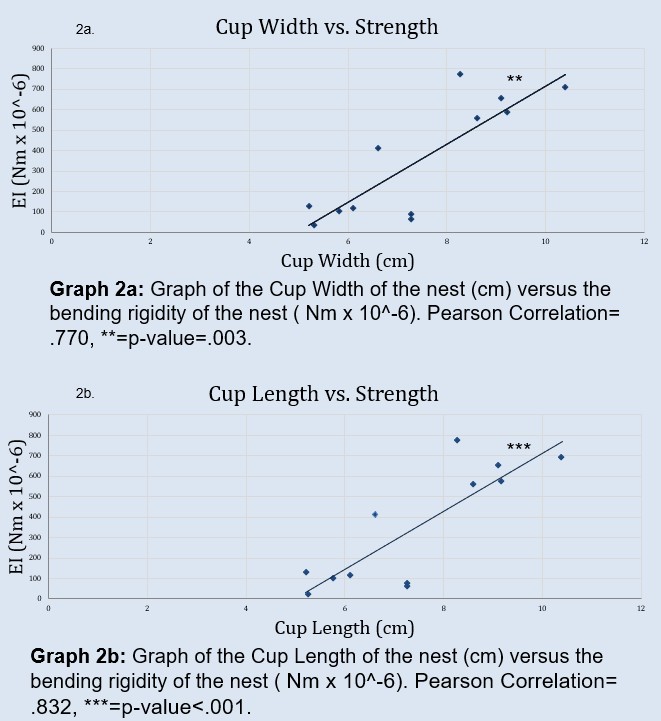
Part 1: Measuring Nest Size: There are five key measurements that were used to understand the shape of the nest: the width, length, height, cup length, and cup height. The width was chosen as the widest part of the nest that ran through the center of the cup and was measured from the top of the nest. Next, the length was measured perpendicular to the width, running through the center of the cup as well. Then, the height was measured from the table where the nest was placed to the highest cluster of sticks (not including any solo stray sticks ). Next, the width and length of the cup were measured. They were measured in the same fashion as the overall width and length, except that the width of the cup was measured along the same line as the width of the nest. The same follows for the measurement of cup length.
Part 2: Measuring Material Orientation: To measure the angle of inclination of the sticks, a photo was taken of the nest. Next, the cardboard square was used to rotate the nest by ninety degrees, and another photo is taken of the nest. This process was repeated for the four sides of the nest. Once this was completed, all photos are imported into the FIJI image editing software. In the software, the average inclination of the sticks above the horizontal was measured.
Part 3-Measure Nest Strength: For strength measurement, the Vernier Structures and Materials Tester was utilized. The nest was first positioned on the top of the tester so that the nest is face up. Then, the U-bolt pulls down on the nest and produce a force versus displacement graph in the Vernier Graphical Analyses software, which is used to calculate the bending rigidity of the nest
Part 4-Nest Dissection: To determine the material placement within the nest, the materials in the nest were sorted based on what position of the nest they were in: the top outer nest, the bottom outer nest, or the cup. Next, I used a digital caliper to measure the diameter of the materials within each section of the nest.
Discussion/Conclusion
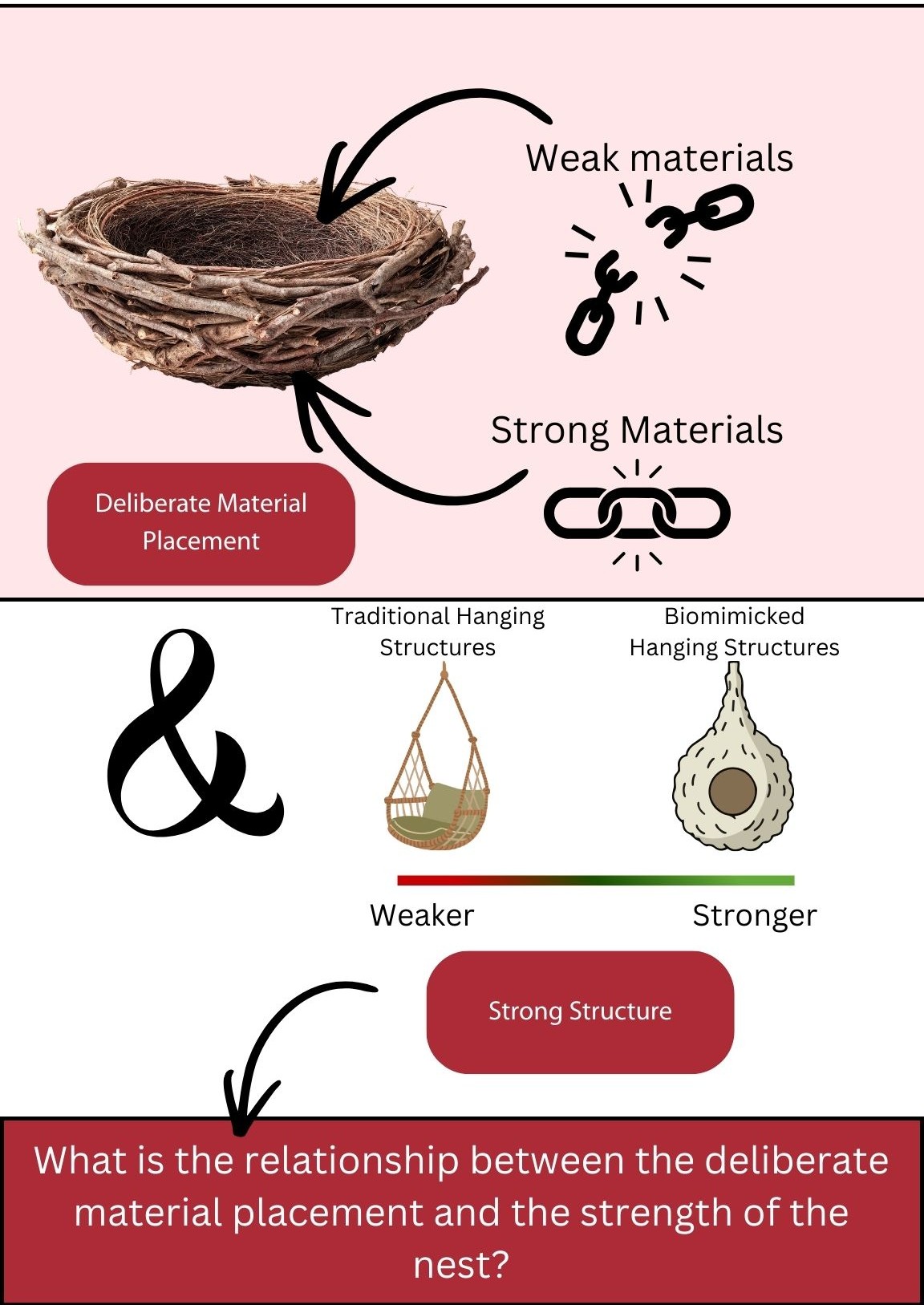
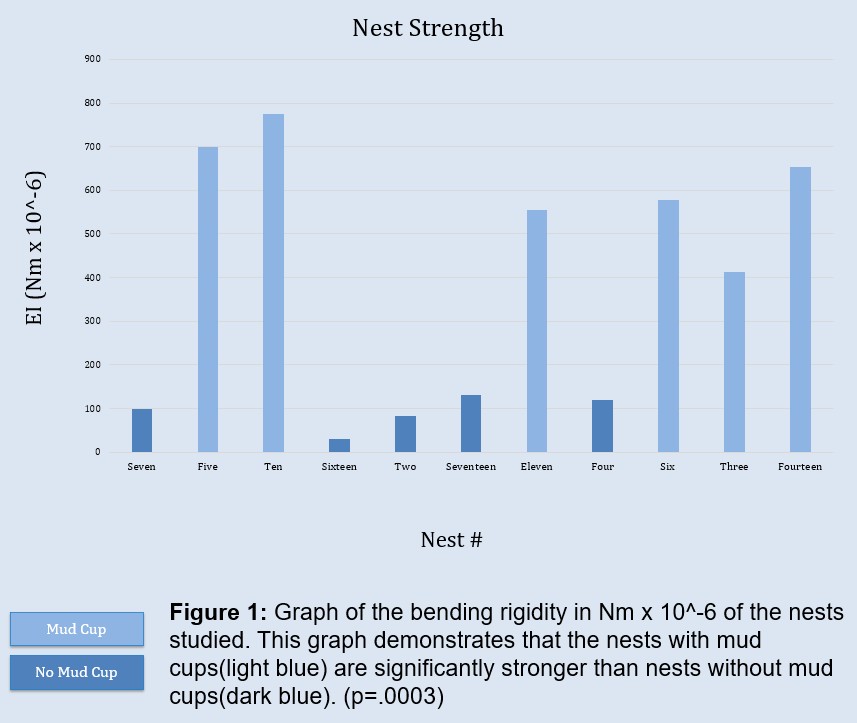
In terms of statistical significance, this data suggests that nest architecture, specifically material diameter and angle of inclination do not lend themselves in any particular way to making a nest stronger. This suggests that materials are chosen and placed in the way they are for reasons other than strength, such as comfort or insulation. However, the results indicate that mud cups are much stronger, suggesting the idea that if birds have the environmental need for a stronger nest, a mud cup would be the optimal choice. Future research necessitates analysis of more nests. This is in part due to statistics involved in the creation of this project. With more nests, statistical testing would be more representative of the population, thus getting a better understanding of how the nest characteristics influence nest strength. In addition, future research can be done analyzing what birds have created nests with mud cups and what their ambient environment is like. This will help to identify why birds would have the necessity to create stronger nests, which will help gain a greater sense of what environmental factors drive birds to prioritize certain characteristics of their nests (ie. Strength, comfort, camouflage, etc.). In addition, the results of my project bear a greater need to identify what the leading reason is for placement of materials, because of the results suggesting they are not placed in the locations they are in for strength. It is essential to understand why placing stronger materials in the outer parts of the nest and weaker materials in the inner parts of the nest remains a pattern within many bird species (Biddle et al., 2018). Finally, future work could be done analyzing the “optimal” characteristics of domes and to analyze whether concrete domes are stronger than steel rod alternatives.
The goal of this project was to gain greater insight into the inner workings and construction patterns of birds and to understand what patterns and features of nest architecture have the strongest influence on the nest strength. To answer this question, data regarding nest size, angle of inclination of materials, diameter of materials, and placement of materials was collected, as well as data on the nest strength. Then, statistical testing, namely correlation tables and linear regression models were utilized to understand the relationships between nest strength and the individual characteristics within the nest architecture. The results have shown no particular significance between nest architecture and strength, except for that of having a mud cup, which will make the nest much stronger. Understanding the world around us is crucial, for it gives us as human a better connection to nature. In addition, nests are a miraculous feat of animal engineering that humans can stand to learn from, so by learning what they use for what reasons can be used to apply to man-made structures, and thus elevate our structures, one by one.
References
Bhosale, Y., Weiner, N., Butler, A., Kim, S. H., Gazzola, M., & King, H. (2022). Micromechanical Origin of Plasticity and Hysteresis in Nestlike Packings. Physical Review Letters, 128(19), 198003. https://doi.org/10.1103/PhysRevLett.128.198003
Biddle, L. E., Deeming, D. C., & Goodman, A. M. (2018). Birds use structural properties when selecting materials for different parts of their nests. Journal of Ornithology, 159(4), 999–1008. https://doi.org/10.1007/s10336-018-1571-y
Biddle, L., Goodman, A. M., & Deeming, D. C. (2017). Construction patterns of birds’ nests provide insight into nest-building behaviours. PeerJ, 5, e3010. https://doi.org/10.7717/peerj.3010
Harvard John A. Paulson School of Engineering and Applied Sciences. (2025, April 8). How do bird nests stay together? Researchers unravel entanglement between stiff, straight rods. https://phys.org/news/2025-04-bird-stay-unravel-entanglement-stiff.html#google_vignette
Jessel, H. R., Aharoni, L., Efroni, S., & Bachelet, I. (2019). A modeling algorithm for exploring the architecture and construction of bird nests. Scientific Reports, 9(1), 14772. https://doi.org/10.1038/s41598-019-51478-1
Lombardo, M. P. (1994). Nest Architecture and Reproductive Performance in Tree Swallows (Tachycineta bicolor). The Auk, 111(4), 814–824. https://doi.org/10.2307/4088813
Sindhu Nachiar, S., Anandh, S., Yegasainathan, N., & Kowsalya, M. (2023). Shape optimization of hanging structure using the concept of Biomimics.Materials Today: Proceedings, 93, 46–53. https://doi.org/10.1016/j.matpr.2023.09.164
Street, S. E., Jaques, R., & De Silva, T. N. (2022). Convergent evolution of elaborate nests as structural defences in birds. Proceedings of the Royal Society B: Biological Sciences, 289(1989), 20221734. https://doi.org/10.1098/rspb.2022.1734