Sept
2026
Applied Math Seminar
Presenting recent work Shallow Water Waves on 2D Strips and Quantum Graphs at Worcester Polytechnic Institute.
Applied mathematics · PDEs · stochastic dynamics · networks
I develop mathematical and computational models for transport, waves, and evolving geometry on networks.
My work connects PDEs on metric graphs, stochastic processes, numerical simulation, and reduced models for complex media, with applications in water waves, heat and mass transport in porous and fractured media, membrane filtration, and biological transport.
I am an Assistant Research Professor in the Department of Mathematical Sciences at Worcester Polytechnic Institute. I am looking for academic positions for Fall 2027.
Recent talks, conferences, workshops, and professional activities.
Presenting recent work Shallow Water Waves on 2D Strips and Quantum Graphs at Worcester Polytechnic Institute.
Organizing (with Ning Wei from Purdue, and Abigail Drumm from WPI) Multiscale Flow and Transport in Biological Soft Matter system at the SIAM New York–New Jersey–Pennsylvania Sectional Meeting, Rutgers University .
Presenting recent work Nonlinear Transport Dynamics on Metric Graphs at UMass Amherst, Amherst, MA.
Presenting recent work Nonlinear Transport Dynamics on Metric Graphs at APS DFD Conference in Orlando.
I study how local dynamics on edges, coupling laws at vertices, network topology, and stochastic events combine to determine global behavior in physical and biological systems.
Wave propagation, transport, reaction, and geometry evolution on metric networks.
Random walks, blocking, fouling, topology change, and graph-based performance metrics.
Graph models derived from conservation laws, asymptotics, and continuum mechanics.
Water waves · metric graphs · scattering
Vertex coupling laws determine how waves transmit and reflect through river, canal, and branched coastal networks.
Mathematical core: Saint-Venant equations, characteristic variables, quantum graphs, width-weighted scattering, source-relative balance.
Note that the left-most edge has no back propagating mode (flat red line), indicating no reflection. It is a result of a particular frequency forced at the incoming boundary that leads to destructive cancellation of all reflected waves generated by the downstream vertex where three internal paths meet. How do you select this frequency?
Key question: Does the Neumann-Kirchhoff vertex condition (conservation of flux and continuity of wave height) always hold for any river channels, independent of geometry (width and angles) and topology (connectivity)?
Read more →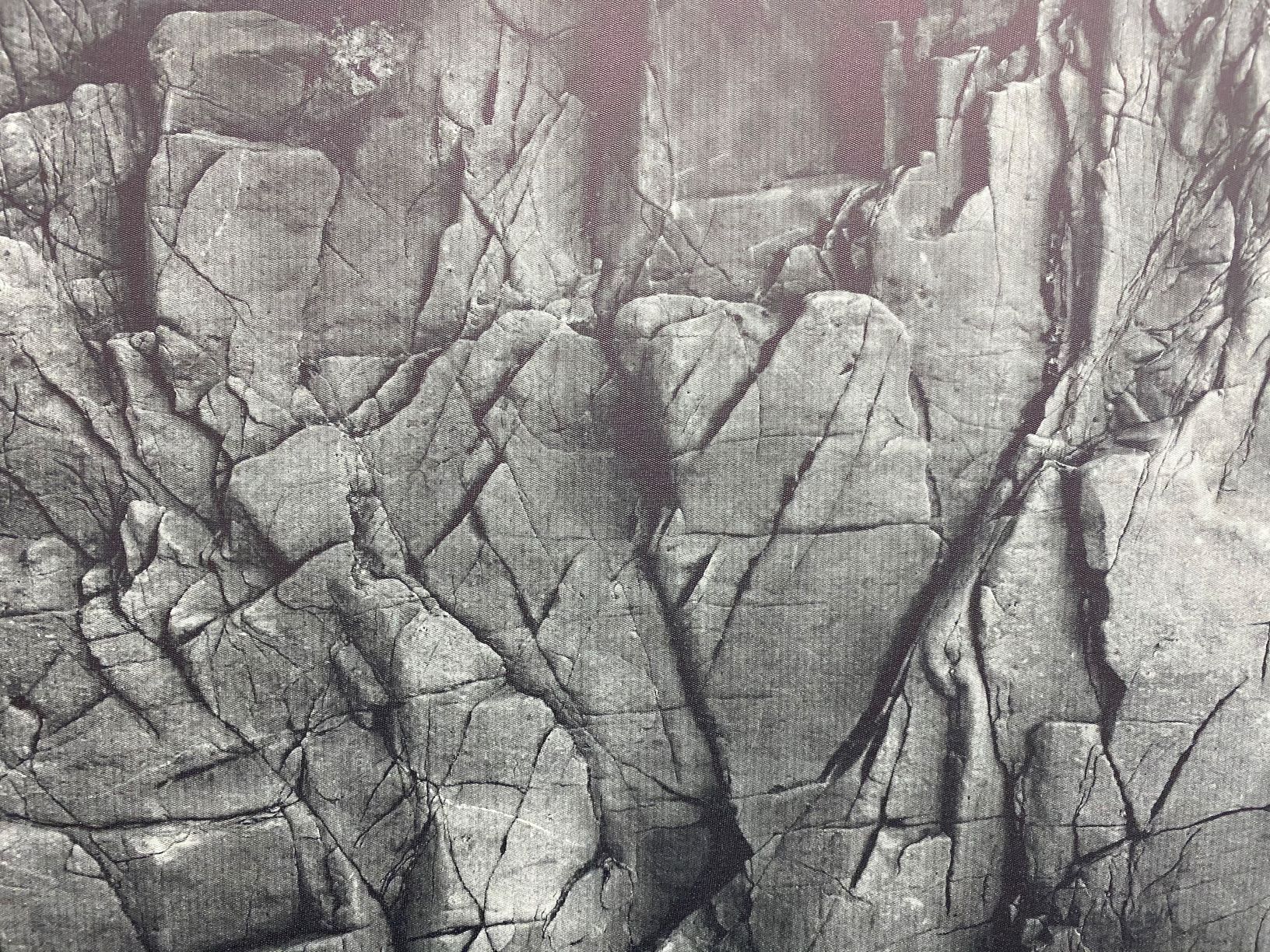
Porous media · Geochemistry · spectral methods
Reduced pore and network models describe how thermal forcing, chemical reactions, and evolving permeability interact in aquifer thermal energy storage. Figure courtesy of Pyramid Environmental & Engineering.
Mathematical core: coupled flow, heat and mass transport, permeability evolution, spectral network solvers.
Key question: How do fluid, heat and mass transport take place in this evolving fractured system?
Read more →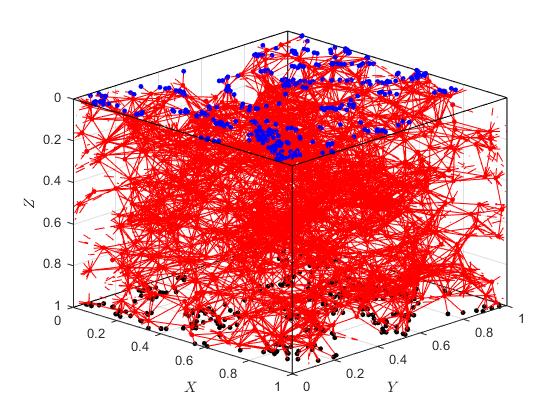
Filtration · Porous Media · Random Graphs · Fouling
Membrane pore networks evolve under adsorption and sieving, combining deterministic conductance loss with random particle-driven blocking.
Mathematical core: weighted graph Laplacians, flux-guided random walks, temporal graphs, persistence-based structure metrics.
Key question: How do fluid and contaminant transport take place in this evolving pore network?
Read more →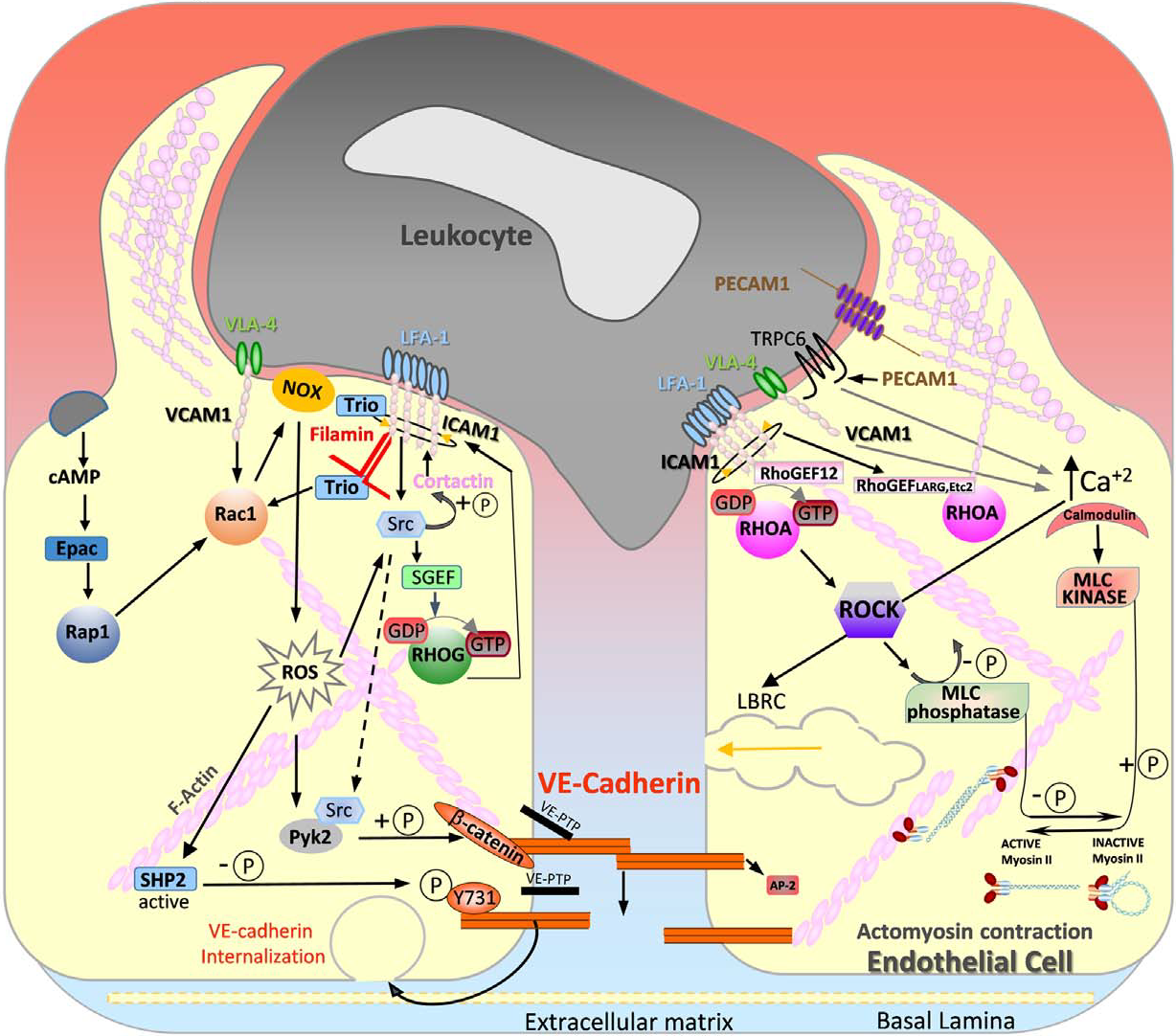
Mathematical biology · physiological flows · growth · mechanics
Models of tissue growth in elastic scaffold networks and neutrophil transit through viscoelastic endothelial clefts connect biological transport to evolving geometry.
Mathematical core: low-Reynolds-number flow, advection–diffusion–reaction, elasticity and viscoelasticity, moving boundaries, and graph coupling.
Figure courtesy of Cerutti & Ridley (2017).
Key question: How do immune cells magically squeeze themselves through tight endothelial junctions to fight inflammations on the brain side?
Read more →I teach applied mathematics through computation, modeling, and structure. Students should learn not only how to execute an algorithm, but why it works, when it fails, and what it reveals about the underlying mathematical problem.
Many of my projects naturally split into student-scale problems involving modeling, computation, asymptotics, or graph algorithms.
For research collaboration, student projects, or teaching inquiries, contact me at bgu [at] wpi [dot] edu.
Current postdoc advisor: Prof. Andre Nachbin.
Former postdoc advisor: Prof. Burt Tilley.
PhD advisors: Prof. Linda J. Cummings and Prof. Lou Kondic.