Thesis research: filtration, porous media, and evolving networks

Membrane Filtration in Pore Networks

How pore connectivity, tortuosity, size variability, grading, and competing fouling mechanisms control filter performance.

A membrane filter must process enough fluid, retain contaminants, and remain operational for a useful lifetime. These objectives compete, and all depend on a hidden pore network that changes as particles accumulate or block pathways.

The research problem

Membrane filtration underpins water purification, bioprocessing, food and chemical production, air filtration, and many biomedical technologies. In each case, the filter must balance hydraulic productivity against particle removal and fouling resistance.

The difficulty lies in the membrane interior. Pores form a heterogeneous, interconnected network, and their hydraulic resistances evolve as particles adsorb onto pore walls or abruptly block pathways. Fully pore-resolved three-dimensional simulation is expensive and often tied to one particular membrane image, while coarse continuum models can suppress the connectivity and path structure that govern redistribution during fouling.

My thesis work developed graph-based pore-network models that preserve the essential geometry and topology while remaining efficient enough for systematic design studies.

\[ q_{ij}=k_{ij}(p_i-p_j), \qquad L_{\!k}\,p=0, \] where each edge represents a pore throat, each vertex represents a pore junction, and the weighted graph Laplacian enforces fluid-flux conservation throughout the network.

Chronological research arc

The papers build from simple questions about connectivity to a general graph formulation, then to variability, deliberate pore-size grading, a field-level synthesis, and finally the interaction of continuous adsorption with discrete stochastic sieving.

2022

A Graphical Representation of Membrane Filtration

SIAM Journal on Applied Mathematics, 82, 950–975.

Punchline: A general graph model reveals two strong structural predictors: initial void volume controls total throughput, while tortuosity controls how much foulant escapes in the filtrate.

2023

Flow through Pore-Size Graded Membrane Pore Networks

Physical Review Fluids, 8, 044502.

Punchline: At fixed porosity, an intermediate pore-radius gradient optimizes performance: larger upstream pores preserve capacity, while smaller downstream pores maintain contaminant removal.

2026

Filtration in Pore Networks

Annual Review of Fluid Mechanics, 58, 221–244.

Punchline: Pore-network models occupy the useful middle ground between detailed pore-resolved simulation and coarse continuum laws, making them a practical framework for next-generation filter design.

2026

Stochastic Modelling of Filtration with Sieving in Graded Pore Networks

Journal of Fluid Mechanics, 1035, A28.

Punchline: Coupling continuous adsorption with Poisson arrivals and flux-weighted random walks for large sieving particles produces abrupt flux decline, adsorption–sieving competition, and a lifetime transition that adsorption-only models cannot capture.

Central progression

From describing pore structure to predicting dynamic failure

The research moves from static network descriptors—connectivity, void volume, tortuosity, and pore-size distribution—to controlled grading and finally to stochastic blockage on an evolving network.

Two structural laws from the graph model

The SIAM graph formulation provided the first general network setting for the later papers and exposed two compact structure–performance relationships.

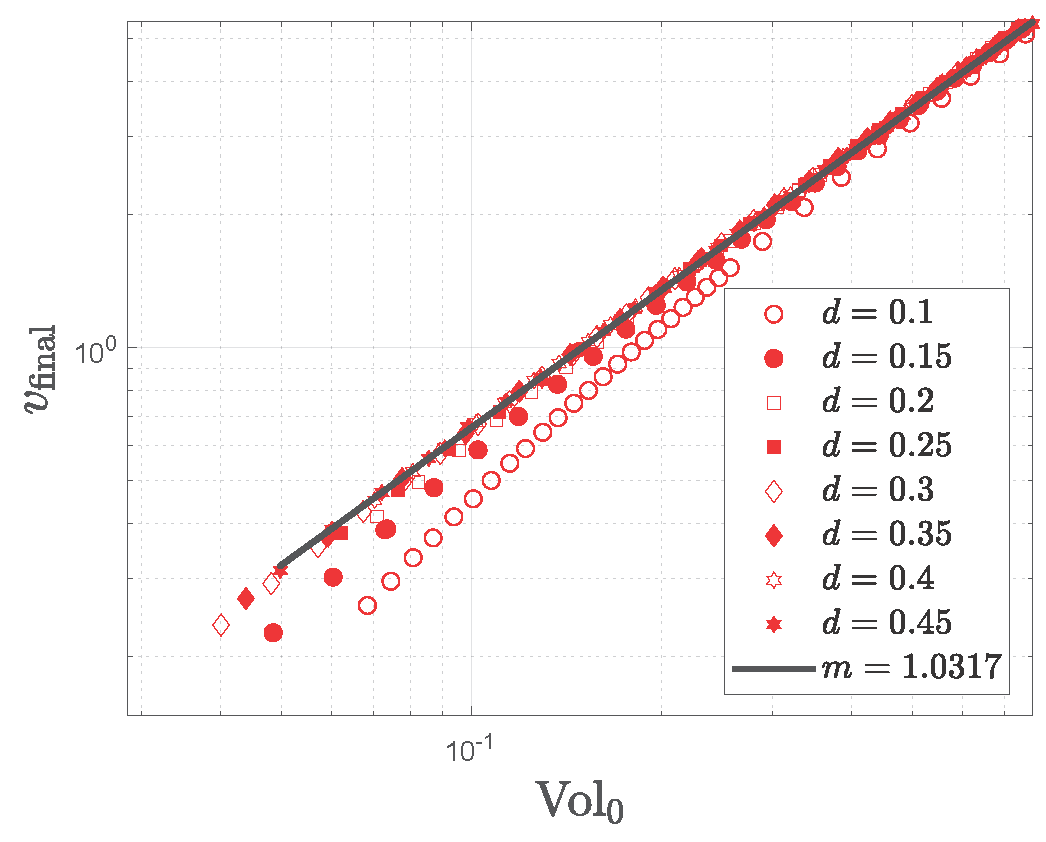
Final filtrate volume versus initial pore volume across network connection radii

Initial void volume predicts throughput

Total filtrate volume follows an approximate power law in the initial pore volume, largely collapsing results across different network connectivities.

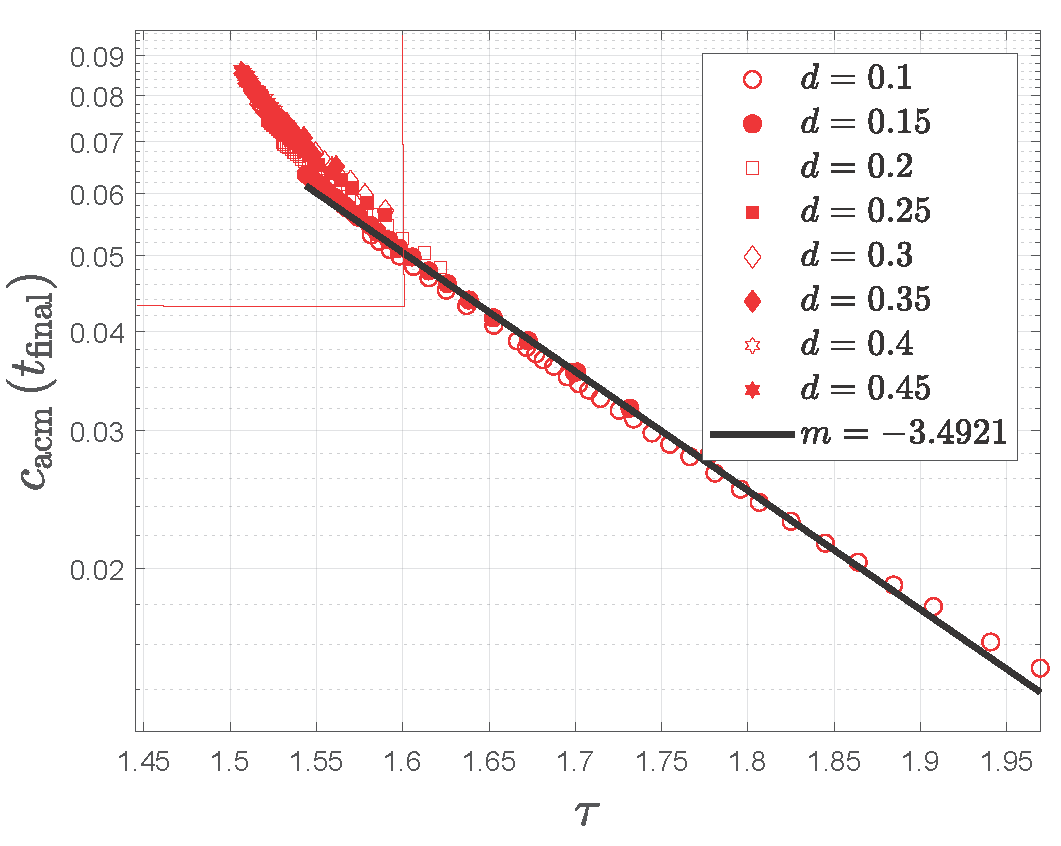
Accumulated outlet foulant concentration versus network tortuosity

Tortuosity predicts foulant escape

Accumulated outlet foulant decreases approximately exponentially with tortuosity: longer network paths improve particle retention.

What the thesis established

The central lesson is that filter performance is not determined by a single geometric statistic. Void volume governs hydraulic capacity, tortuosity governs retention, pore-size variability creates a throughput–purity tradeoff, grading can deliberately redistribute fouling, and stochastic blockage can qualitatively change failure dynamics.

The graph framework makes these effects comparable within one mathematical language and provides a direct route from pore-scale physics to practical design questions.