Source-relative balance, vertex scattering, and synchronization effects in one-dimensional shallow-water networks.
River basins, canal systems, and branched coastal geometries can often be reduced to metric graphs: waves propagate along edges and scatter at junctions. The central question is when a locally balanced network junction transmits a disturbance without sending a reflected wave back upstream.
In a one-dimensional shallow-water network, each channel carries the linearized Saint-Venant equations. After diagonalization, the dynamics separate into upstream- and downstream-propagating characteristic modes. At each vertex, height continuity and width-weighted flux conservation determine a scattering law for the incoming and outgoing characteristic amplitudes.
The main point is that balance is not just a geometric property of a junction. It is also a statement about which edges are active sources at the moment a wave arrives. A junction can be transparent for one incoming pattern and reflective for another, even with the same channel widths.
Cycles introduce a second obstruction. Even if each junction is locally balanced, partial waves traveling along different paths must arrive synchronously at the recombining vertex. Equal travel times give broadband transparency; unequal travel times create reflection unless the forcing frequency hits special cancellation values.
Mathematical core
On each edge, the linearized shallow-water equations are written in characteristic variables. At a vertex \(\nu\), let \(\alpha\) collect incoming amplitudes and \(\beta\) collect outgoing amplitudes. The vertex conditions produce the explicit scattering law
Here \(B_e\) is the channel width of edge \(e\). This formula applies to arbitrary-degree junctions and unifies converging and diverging junctions: the scattering matrix is the same, while the incoming/outgoing bookkeeping changes with edge orientation.
For a source set \(\Sigma\subset E_\nu\), balance means
At balance, the source-source reflection block annihilates the synchronized incoming direction. Thus a balanced vertex is transparent only to the synchronized component on the active source edges.
Results and visual demonstrations
The visual results below follow the logic of the paper. We first isolate the
local scattering mechanism at a single balanced vertex. We then move to an
island graph, where local balance alone is no longer enough: the split waves
must also arrive synchronously at the recombining junction. Finally, we show
how unequal path lengths can still suppress reflection at selected
frequencies predicted by the reflection factor \(\mathcal H(\omega)\).
Local vertex transparency: source-relative balance
The first three movies remove cycles from the problem and focus only on one
junction. In this setting, transparency is controlled by two pieces of data:
the channel-width weights and the active source set. A balanced vertex is
transparent to the synchronized incoming mode on the source edges, but not
necessarily to arbitrary incoming data.
Converging junction: synchronized source mode
Two incoming branches drive a balanced converging junction. Because the
source-side widths balance the outgoing width and the incoming pulses
are synchronized, the reflected characteristic components on the source
branches vanish.
Diverging junction: same law, different source set
The diverging case uses the same width-weighted scattering matrix as
the converging case. What changes is the assignment of incoming and
outgoing characteristic modes. With the correct source-relative balance,
the initial pulse splits without upstream reflection.
Degree-four star graph: balance is not a Y-junction artifact
Two synchronized source edges transmit through a degree-four balanced
vertex without reflection. This demonstrates the general mechanism:
transparency depends on the source set and the width sums, not on the
junction being a three-edge graph.
Island graphs: local balance versus synchronization
The island examples introduce a cycle. The first junction splits the incoming
disturbance into two paths, and the second junction recombines the partial
waves. Both junctions may be locally balanced, but the recombining junction
is transparent only if the two arrivals enter in the synchronized source
direction.
Equal path lengths: broadband transparency
The two split pulses arrive at the recombining junction at the same
time. The incoming data therefore remain in the transparent synchronized
mode, and the locally balanced island transmits the disturbance without
first-generation upstream reflection.
Unequal path lengths: reflection from desynchronization
The same local balance conditions hold at both junctions, but the two
partial waves arrive at different times. The recombining vertex then
sees a nonsynchronized source vector, and the nonsynchronized component
is scattered back upstream.
Frequency-selective cancellation
Unequal path lengths do not give broadband transparency, but they can still
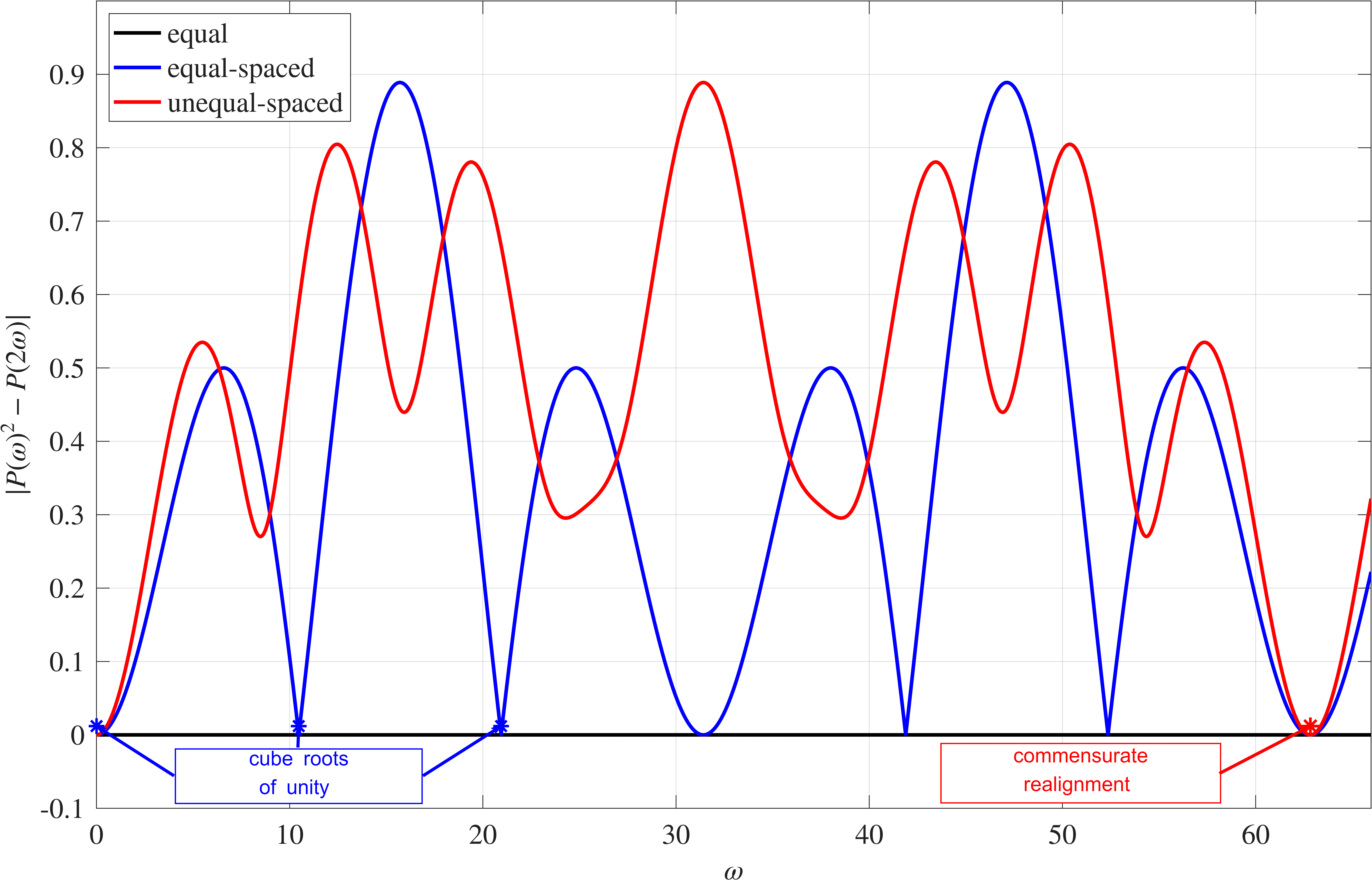
cancel reflection at isolated frequencies. The figure summarizes the
frequency-domain criterion through
\(\mathcal H(\omega)=P(\omega)^2-P(2\omega)\). The accompanying movie uses
a harmonic incoming disturbance tuned to one of these zeros. In that case,
the upstream reflected \(v\)-component on the source edge is absent, even
though the island paths are not equal in length.
Reflection factor
Frequency-domain zeros of \(\mathcal H(\omega)\), showing broadband,
commensurate, and frequency-selective cancellation regimes.
The reflection factor separates the cancellation mechanisms for
balanced multi-path islands. Equal travel times give broadband
transparency; commensurate unequal paths give periodic zeros; and
larger multi-path networks can support additional phase-cancellation
regimes.
Harmonic input at a cancellation frequency
The initial condition is chosen at a frequency where
\(\mathcal H(\omega)=0\). The diagnostic feature is the missing
upstream reflected \(v\)-component on the incoming source edge (in red, and quiescent): the
island is not broadband transparent, but it is transparent to this
selected harmonic. The internal reflected waves destructively interfere at the left junction at the selective frequency.
The paper derives the arbitrary-degree width-weighted vertex scattering law, introduces source-relative balance, and shows that cyclic balanced networks require synchronization of path travel times for full transparency.
Next direction: two-dimensional graph limits
The current one-dimensional theory isolates scattering generated by vertex coupling and path delays. The next direction asks how this graph description survives when the channels are treated as thin two-dimensional domains. In that setting, branch angle, finite width, and local junction geometry may affect the effective coupling condition in the graph limit.
2D Propagation of a linear shallow-water wave through a two-dimensional symmetric Y-junction.
No vertex conditions are imposed; the solution is obtained directly from the 2D linearized shallow water equations. For balanced widths and symmetric branching angles, the transmission agrees remarkably well with the Neumann–Kirchhoff junction conditions. The broader objective is to determine how this agreement depends on wavelength, channel geometry, and network topology.
The goal is to compare two-dimensional shallow-water simulations in forked channels with the reduced graph model, and to identify when Neumann-Kirchhoff or Stoker-type coupling is physically compatible with the underlying continuum problem.