After February STEM Fair, the second half of STEM consists of Assistive Technology projects. These projects occur from February to May. These projects focus on identifying a problem in the community and creating an assistive device to solve it. The coursework consists of creating entries about daily work in a logbook, conducting research and design studies to make informed design decisions, and ultimately creating a prototype that aligns with all Level 1 requirements (determined at the start of the project) to deliver to Client X and present our device at the May Assistive Technology Fair. My assistive technology group consisted of Parnitha K., Aishani G., and Saara P. I was Chief Manufacturing Officer. Our project is called HemoLimb. Scroll down for more information!
Around 20% of children and adolescents experience hemovisualization-related psychogenic paraesthesia (Bhatia, 2015). This disease can cause mobility issues due to numbness in certain body parts. Current methods to treat this numbness include fist clenching and applying pressure to increase blood circulation. These methods, though effective, require more client effort and are more time-consuming. Studies have demonstrated how compression can help individuals regain function in their body parts after experiencing numbness (Cleveland Clinic, 2025). Through compression, inflammation can be reduced, leading to blood circulation restoration. Therefore, our device aims to effectively reduce numbness due to hemovisualization-related psychogenic paraesthesia through a compression therapy device.
In order to aid our client, our group proposes building a compression sleeve-style device to apply pressure in waves.
The purpose is to help return blood circulation to the arm and return movement for the client, speeding up the recovery process after an episode.
The three design concepts include: a vibration therapy compression sleeve, a vibration therapy targeting nerves bracelet, and a step-motor-driven compression sleeve. The vibration therapy compression sleeve was chosen as our final design,
as it aligned closely with our client needs. Though the other designs were not used, they provided useful insight into the production of our final design and provided valuable design feedback.
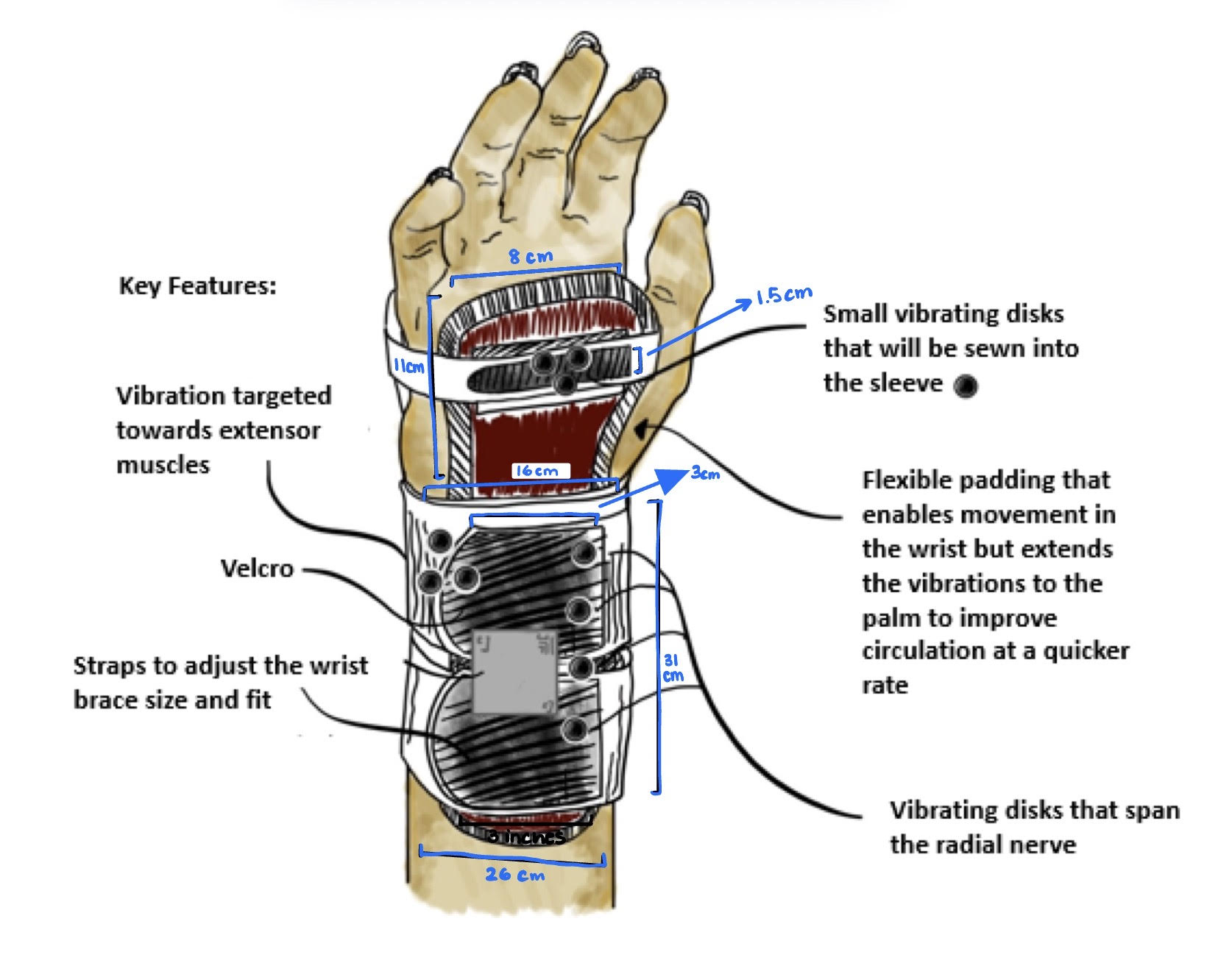
Vibration Therapy Compression Sleeve: This concept will utilize vibration therapy to increase blood circulation in the client's arm.
Through bursts of vibration in intervals of 10-15 seconds, this device will reduce the numbness in the arm by improving circulation, thus relieving the client of the tingling or discomforting sensation.
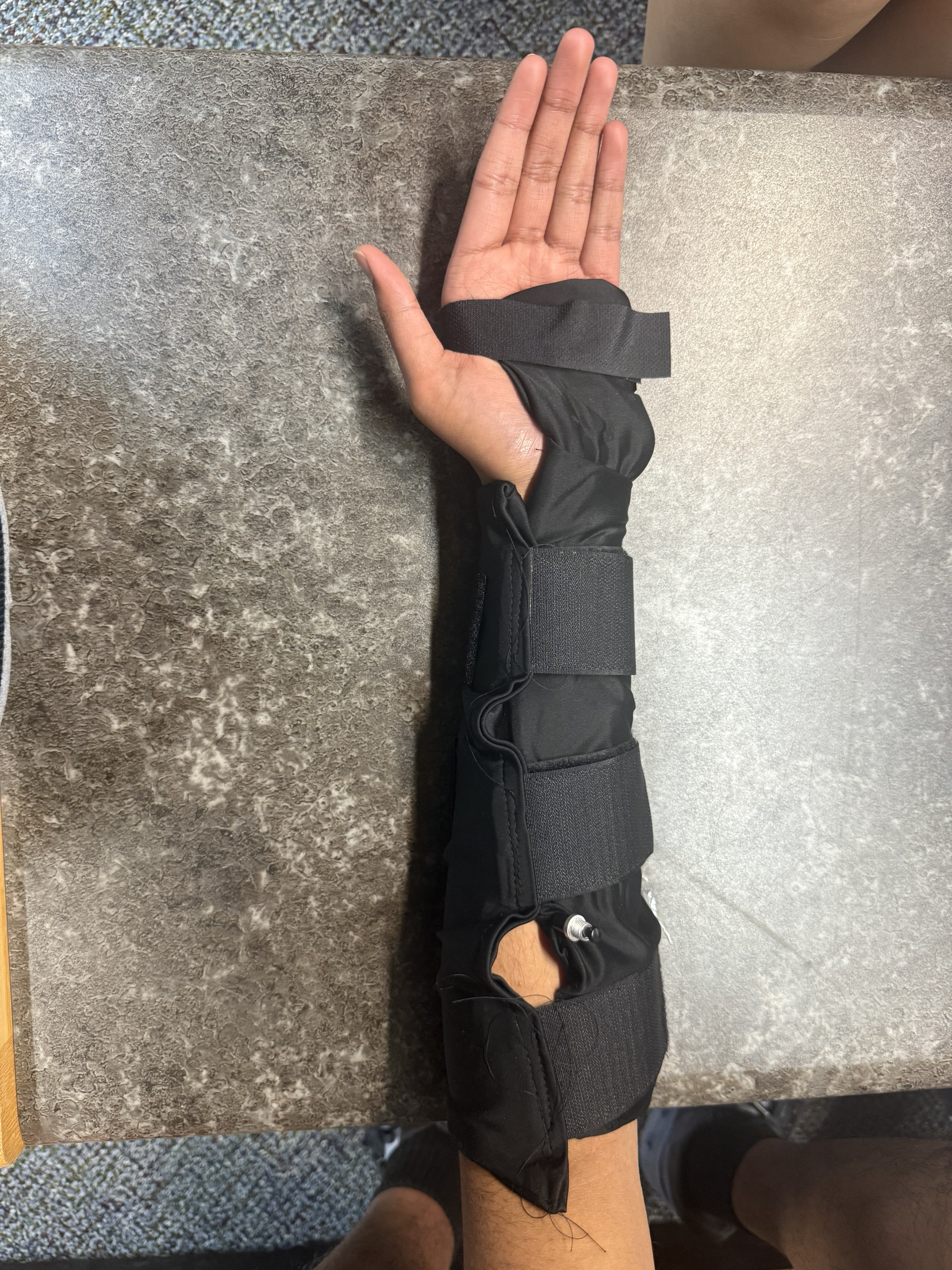
In our prototype, vibration motors are placed at anatomically strategic points in the sleeve (which is constructed with a lightweight, breathable, and non-irritating material), such as the extensor muscles, palm, and radial artery.
Vibration Therapy Targeting Nerves Bracelet: This design concept utilizes vibration stimulation targeted at the superficial radial nerve. Using a vibration motor embedded into a thin wristband sleeve, the device will allow for vibration located specifically at the superficial radial nerve.
Stimulation targeted at the superficial radial nerve has been shown to help reverse vasoconstriction. The thin wristband sleeve will be made of a breathable material and will be effective in hiding the internal device components.
Step-Motor Driven Compression Sleeve: This design utilizes a step motor to contract the width of the compression sleeve, making it smaller and more compressive in intervals.
This will allow pressure to be applied to stimulate blood flow and return feeling to the client. The step motor will turn for 15 seconds, wrapping the elastic portion of the sleeve onto itself.
This will reduce the size of the sleeve and consequently apply pressure. Then, it will spin the other way, to release for 15 seconds. This process repeats for about 15 minutes, the duration of the client's episode.
Trouble viewing the PDF? Click here!