Computer Science!

In Computer Science, Ms. Taricco challenges us with exercises and labs that not only help us grasp concepts and use them towards practical applications, but are fun as well. Despite prior knowledge, this class familiarizes you with languages such as HTML, CSS, and Java. Past applications and projects include calculating federal tax rates, number guessing games, and a dart simulation to estimate the value of pi.

One of the mini-labs that we completed while learning Java was one with graphics. In this lab, we were given an image to replicate using the graphics class. However, one of the biggest challenges was connecting math concepts to the design process to improve efficiency. Click this link to see my code!

Another lab we were assigned mocked the game of Bulgarian Solitaire. In this game, players start with a triangular number of cards, which are divided into a random number of piles that contain a random number of cards. Each round, one card is removed from each pile, creating a new pile. The game is finished when the player ends with a series of cards in piles of consecutive numbers. For example, a player starting with 21 cards must end with piles of 1, 2, 3, 4, 5, and 6. An example of a game using this deck size is shown to the right. Click this link to see my code!

StrokeScope

What's the Problem?

Strokes are the fifth leading cause of death in the United States and the second leading cause of death worldwide (NINDS Recognizes Stroke Awareness Month | National Institute of Neurological Disorders and Stroke, 2024). Every 40 seconds, an individual suffers from a stroke in the U.S., with a death occurring every three minutes (CDC, 2025). These devastating incidents are the result of “brain attacks,” times at which the brain is cut off from blood circulation, and oxygen is not able to properly reach brain cells. Deprived of vital nutrients, the brain loses nearly two million functioning cells each minute (CDC, 2025). While this damage can be minimized if blood flow is restored quickly, the body's natural response often can cause further harm by exerting pressure on the skull and creating tissue damage that cannot be repaired. These outcomes can often lead to seizures or other permanent impairments, making strokes the primary contributor to serious long-term disabilities (CDC, 2025).

Target Audience

The target audience for our app includes the general public, who may not fully understand imaging results or need to wait for long periods of time before receiving a medical professionals' analysis, students, and researchers studying neurology, medicine, or artificial intelligence, and health care providers who may not have access to expensive imaging software.

Our Solution and Minimum Viable Product

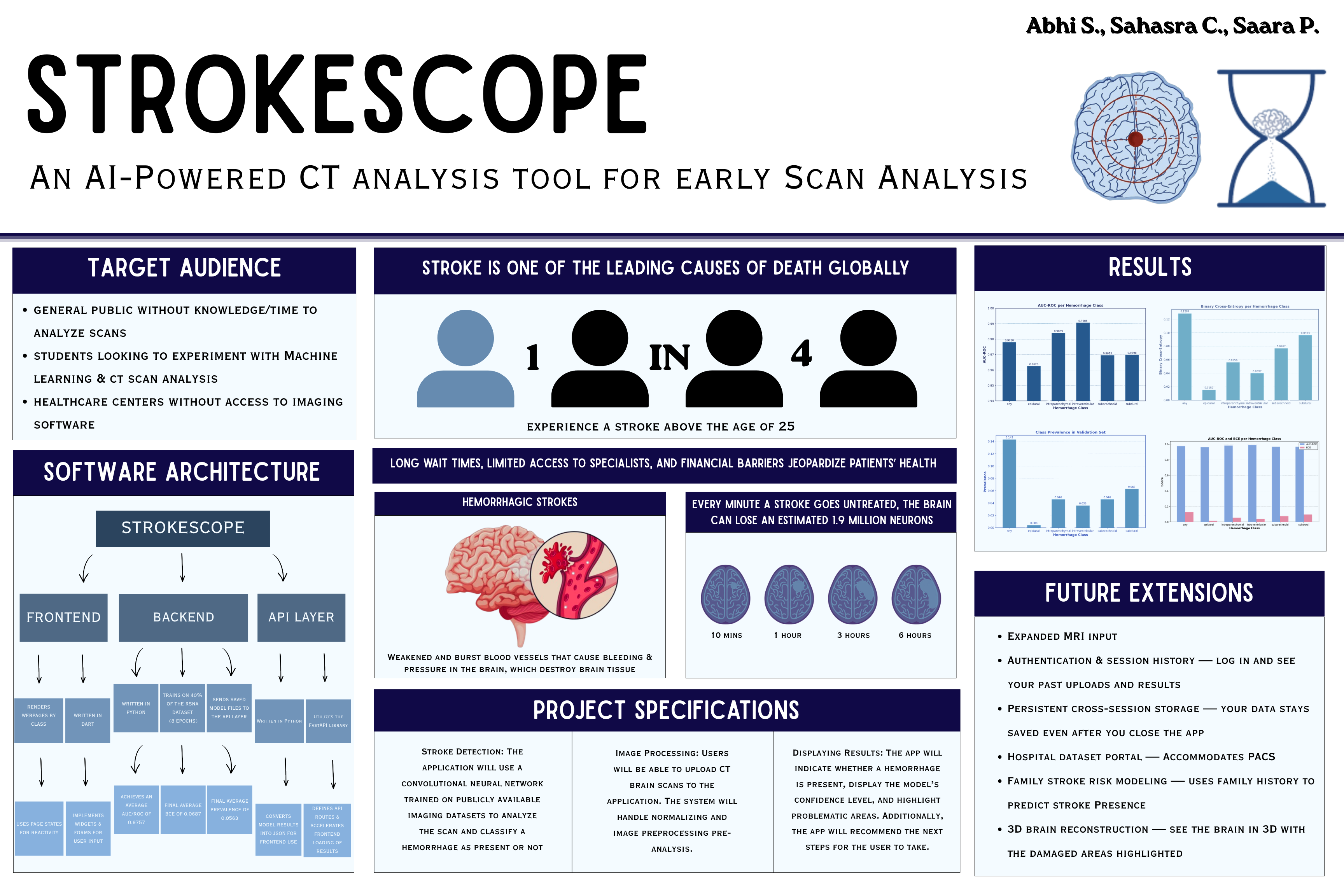
StrokeScope is a web application utilizing machine learning-based image classification of brain scans to identify potential signs of stroke. Users will be able to upload CT (Computed Tomography) scan results, and a convolutional neural network-based architecture will identify similarities present within the scan and images in its training dataset. The model will then classify the scan as hemorrhagic or not. The app will also highlight specific findings in the image, such as unique marks or abnormalities on regions of the brain, that led to its conclusion. Finally, the app will include a confidence level of the model’s prediction. To learn more, reference the "Project Specifications" located on our poster!

The goal of this project is to make stroke detection tools more accessible to a wider range of patients. While the app is not meant to replace doctors or provide medical advice, it can help identify warning signs earlier and encourage users to seek professional medical care as soon as possible.

Poster

StrokeScope project poster

In the Future

Lesion Segmentation and Brain Mapping:

The app would continue by identifying the exact region of the brain affected by the stroke. The system could highlight damaged areas directly on CT or MRI scans and overlay the affected region onto the original image. This would allow users to see where the stroke occurred and estimate the measurement of the infarct volume (the amount of brain tissue damaged due to the lack of oxygen) or the hemorrhage size. The system could also analyze structural changes such as the midline shift, which occurs when pressure from the damaged tissue pushes parts of the brain away from their normal position.

Advanced Stroke Classification

The MVP focuses on identifying whether a stroke is present and determining if it is ischemic or hemorrhagic. As a potential add-on, the model will expand to perform more detailed stroke classifications, including subtypes for strokes such as large vessel occlusions.

Patient Access and Imaging Tools

The app would continue to implement more advanced tools for patient interactions with medical imaging. The platform will host a patient dashboard where users can store past scans, review previous analyses, and track stroke risk over time. Also, the app would include a security login page with a username, password, and an OTP to ensure the app follows HIPAA guidelines. Additional tools, such as a 3D brain reconstruction and downloadable radiology-style report, could help make the results easier to understand and share with healthcare professionals.

Testing