Research
Our group studies how fires and explosions start, grow and can be controlled in industrial settings. The work combines laboratory experiments, large-scale tests and simple physical models that engineers can use in design.
Dust and gas explosions
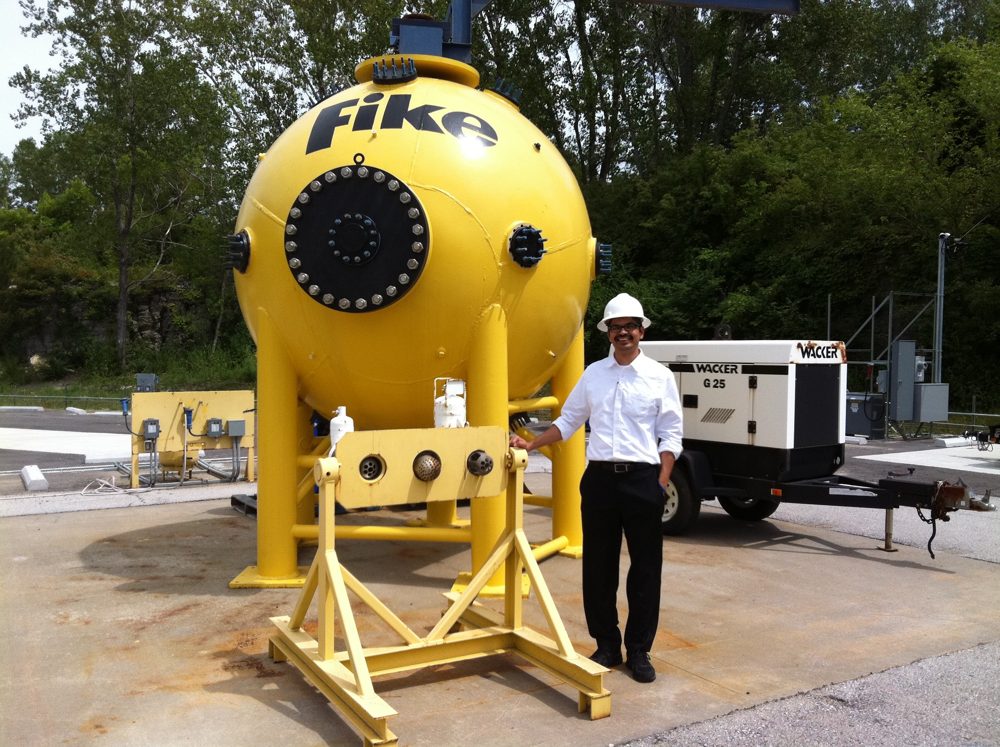
Combustible dust is a leading cause of industrial explosions. We study the ignition of dust layers on hot surfaces, off-gassing of dust layers heated below their ignition temperature and the build-up of flammable vapors in ventilated rooms, flame propagation through dust clouds, and the behavior of standard test vessels used to rate dust hazards.
Related work covers flammable vapor build-up from liquid spills in vented enclosures, ember transport in pneumatic ducts, vented explosions, and incident analysis such as the 2022 Boksburg BLEVE. Much of this material is collected in the textbook Explosion Dynamics (Wiley, 2023).
Oil spill response by in situ burning
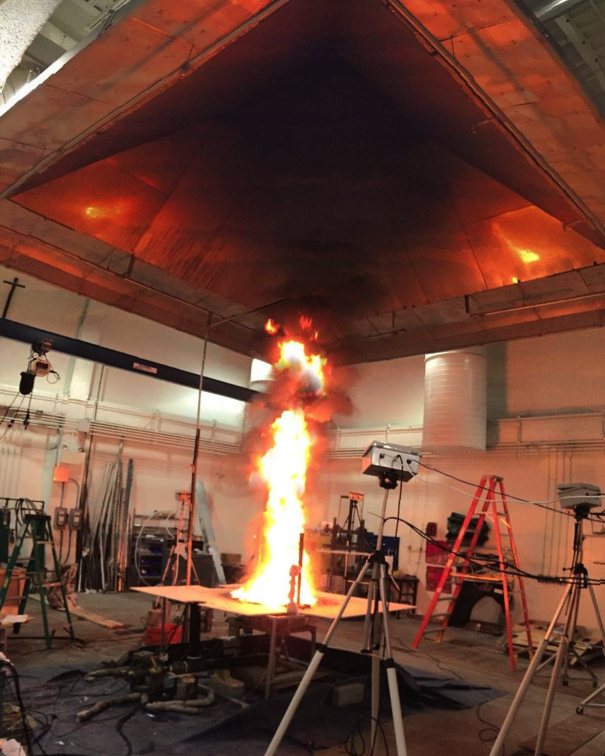
Burning an oil spill where it floats can remove most of the oil quickly, but thin and weathered slicks are hard to ignite and burn poorly. We study the ignition of weathered crude oil, burning of oil on ice, in snow and on turbulent and wavy water, and foaming and boiling effects during burning.
This work led to the Flame Refluxer, a floating system of immersed conductive objects that feeds heat from the flame back into the oil and raises the burning rate. The technology is patented and has been developed through several programs with the Bureau of Safety and Environmental Enforcement (BSEE).
In the news: NPR, “Researchers Test Hotter, Faster And Cleaner Way To Fight Oil Spills” (2017)
Flame spread and material flammability
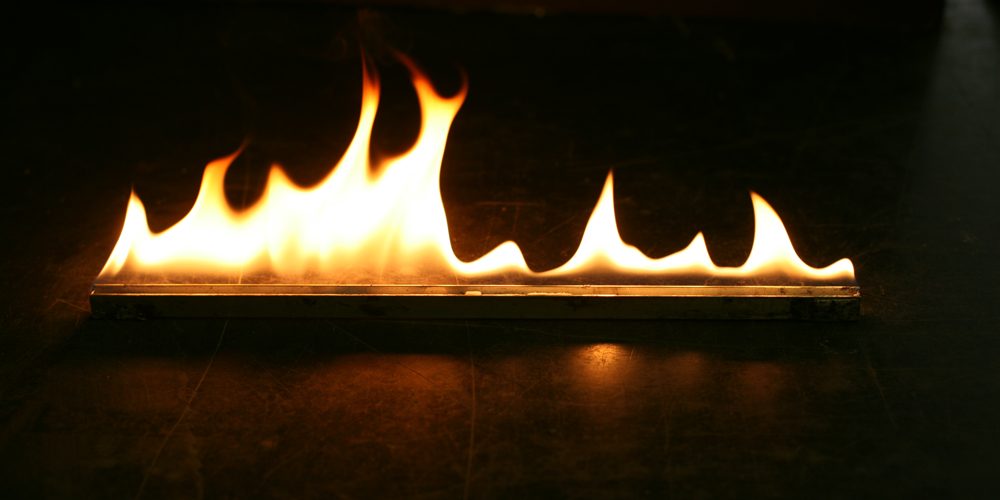
We develop measurement methods and models for how flames spread over solid and liquid fuels and how fast they burn, including the B-number approach to flammability, classification of warehouse storage commodities, heat release of large pool fires, and fire-induced flows.
Fundamentals of this area are covered in the textbook Mechanism of Fires: Chemistry and Physical Aspects (Springer, 2022).
Portable fuel containers
Work on the flammability of vapors inside portable gasoline containers, and on flame arrestors that prevent flashback into them, led to ASTM F3429, the Standard Specification for Performance of Flame Mitigation Devices Installed in Disposable and Pre-Filled Flammable Liquid Containers (in effect since 2020).
In the news: NBC News, “Watch a gas can explode in a lab test”
Facilities
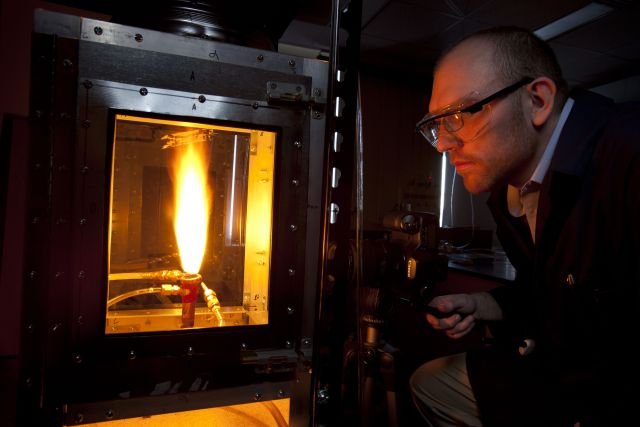
The group runs the WPI Combustion Laboratory and has access to WPI's large-scale fire laboratory, which can run fires up to roughly 5 MW.
Sponsors
Our research has been supported by the National Science Foundation (CAREER Award), the Bureau of Safety and Environmental Enforcement (BSEE), ASTM International, the Alpha Foundation, FM Global, the U.S. Navy, United Technologies Research Center, the UK Engineering and Physical Sciences Research Council, the Danish Council for Independent Research, Alyeska Pipeline, Saudi Aramco, the Society of Fire Protection Engineers, Tyco, 3M, and industry sponsors of the XPE program.