Edible interfaces for immersive human-food interaction to enhance flavor, play, and presence with retronasal olfaction
Year Active: 2024–current
Retronasal Olfaction
I collaborated on a project related to novel edible interfaces designed to synchronize natural eating behaviors with immersive digital experiences by integrating flavor, scent, and touch directly into virtual reality (VR). By leveraging retronasal olfaction (the sensation of flavor when odors travel from the mouth to the nose), this system goes beyond visual and auditory feedback and has the potential to unlock new multisensory applications for games, playful food interactions, and immersive learning.
Read more about the fabrication and performance study on the edible interface AromaBite: (Li et al., 2025).
In a more recent study, we made Aromabites from rice paper and filled them with food-safe scents (fruity, herbal, spicy, and even “non-edible” for playful experiences). We used a variety of textures to enhance the tactile sensation of eating and tested with users. I led the development of a custom Quest 3 VR scenario in Unity that aligns physical and digital food via hand tracking, letting users naturally reach, bite, and taste in sync with the VR environment. Our studies showed that the approach increases immersion and presence without increasing cognitive workload, and users can actively modulate their own flavor experience during gameplay or exploration.
The research paper is currently under review. More information will be released after publication.
References
2025
AromaBite: Augmenting Flavor Experiences Through Edible Retronasal Scent Release
Yucheng Li, Yanan Wang, Mengyuan Xiong, Max Chen, Yifan Yan, and 3 more authors
In Proceedings of the Extended Abstracts of the CHI Conference on Human Factors in Computing Systems, Yokohama, Japan, 2025
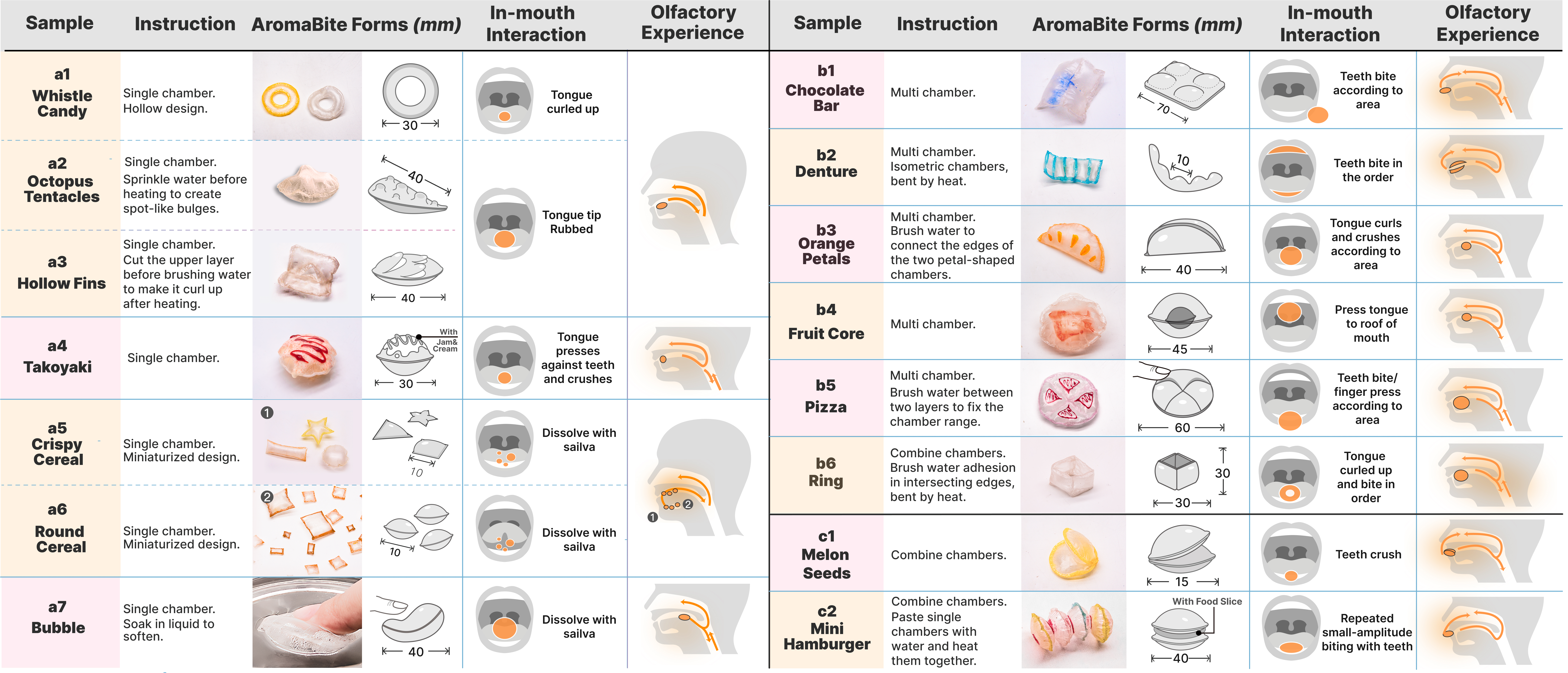
Compared to the five basic tastes, smell, as an intrinsic element, is crucial in augmenting flavor and dietary experience within Human-Food Interaction. While much research has explored orthonasal olfaction in olfactory displays, the potential of retronasal olfaction in interaction design is always overlooked and less understood. This paper introduces AromaBite, an accessible, edible, bio-compatible and ingestible odor storage and release mechanism that integrates natural eating behaviors, providing dynamic retronasal olfactory experiences. We detail AromaBite’s design parameters and process and technically test its airtightness and durability. We employ time-intensity (TI), confirming that retronasal olfaction significantly enhances flavor perception and providing a design library mapping form factors to guide natural oral interaction. We envision that AromaBite will augment depth and immersive flavor experiences in Virtual Reality, olfactory training, and personalized dining interactions.
@inproceedings{li2025aromabite,author={Li, Yucheng and Wang, Yanan and Xiong, Mengyuan and Chen, Max and Yan, Yifan and Li, Junxian and Wang, Qi and Hansen, Preben},title={AromaBite: Augmenting Flavor Experiences Through Edible Retronasal Scent Release},year={2025},isbn={9798400713958},publisher={Association for Computing Machinery},address={New York, NY, USA},url={https://doi.org/10.1145/3706599.3720200},doi={10.1145/3706599.3720200},booktitle={Proceedings of the Extended Abstracts of the CHI Conference on Human Factors in Computing Systems},articleno={76},numpages={8},keywords={Flavor Augmentation, Retronasal Olfaction, Human-Food Interaction, Scent Releasing, Natural interactivity, Edibles},location={Yokohama, Japan},series={CHI EA '25}}