ECE3204 -- D2015
Microelectronics II Course Outcomes
Official Outcomes (Approved by ECE Department)
Students who pass ECE3204 should be able to:
Explain the role of analog circuitry at the input (sensor-to-A/D)
and output (D/A-to-actuator) interfaces in a mixed signal system.
Design inverting and noninverting op-amp circuits to meet a given
performance goal, including specification of op-amp parameters (such as
gain-bandwidth product)
Relate circuit outputs to circuit inputs, using analysis tools
such as the transfer function and Bode plots, that account for both
amplitude and phase effects.
Identify and mitigate the effects of nonideal behavior of op-amps
including both static (DC errors, voltage and current limits) and
dynamic (bandwidth and slew rate limits) effects.
Analyze and design with nonlinear and mixed-signal circuits such
as comparator, Schmitt trigger, timer circuits (e.g. LM555),
sample-and-hold amplifier.
Design active filters for use in applications such as
antialiasing in front of an analog-to-digital converter.
Use laboratory equipment to experimentally verify performance of
all of the above circuitry.
Unofficial Outcomes (Important to Me!)
Students who do well in ECE3204 will be able to:
Function effectively as the resource for analog and mixed
analog-digital circuit design tasks on
a multidisciplinary MQP team.
Ace their job interview by demonstrating clear thinking on a wide
variety of questions (including "trick questions") with
technically-minded companies.
If desired, take more advanced senior and graduate level
microelectronics courses such as ECE4902 (Analog IC Design) and ECE4904
(Semiconductor Devices).
The Microelectronics II Mantra (repeat daily):
IF
an op-amp circuit is
connected for negative feedback,
AND
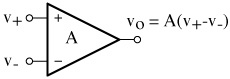
the op-amp open-loop gain
A is sufficiently
high,
THEN
the op-amp input voltages
v- ~ v+ are
approximately equal.