Algebra
last updated April 13, 2007
The purpose of this module is to review or introduce the bulk of the algebra you will need in order to succeed in calculus. It will focus on skills and concepts. It require some memorization and a lot of practice. There are no shortcuts around either. This is also a “no frills” approach and everything presented here should be taken seriously or it would not be here.
Contents:
1. Fractions
2. Exponents
integer powers
roots
negative numbers and
exponents
3. Expansions
basics
expansions with Pascal’s
Triangle
4. Factoring
5. Logs
6. Series
notation
Arithmetic series and
Gauss’ Formula
Geometric Series
There are also a total of 7 Problem Sets to be
done; solutions are provided as well
1. Fractions
Fractions are of the form a/b where a and b are usually integers. The top number, a , is called the numerator and b is called the denominator. Lots of fractions are equivalent as the numerator and denominators have factors in common.
5/8 , 10/16, 20/32 etc are all equivalent.
First you have to be able to add fractions. You can only do this if you have the same denominator. Otherwise you have an “apples and oranges” dilemma with different units. This is perhaps helped by thinking of 5/8 as 5 of the unit 1/8th. For example, we have taken a pizza and divided it into 8 equal parts and we have 5 of them. We have 5 of the 8 parts of a whole (pizza).
Remember: you cannot add fractions unless you have a common denominator!
Suppose now we want to add 5/8 and 2/3. How much total will we have?? We can only add like units but eighths and thirds are different units. We need a common unit. It is 24th. Easily we know that 1/8 = 3/24 so 5/8 = (5*3)/24 or 15/24 Similarly 1/3 = 8/24 so 2/3 = 16/24. Thus to solve the problem,
5/8 + 2/3 = 15/24 + 16/24 = (15 +
16)/24 = 31/24.
We have 31/24 of a pizza or 1 whole pizza and 7/24 of another one.
Example 2: What is 3/8 + 1/5 ?
solution: 40 =
8*5 so
3/8 + 1/5 = 15/40 + 8/40 = (15 + 8)/40 = 23/40
Example 3: What is 1/4 + 3/16?
solution: 16 is a common denominator so only one fraction needs to be modified. Thus
1/4 + 3/16 =
4/16 + 3/16 = 7/16
Example 4: What is 1/3 + 1/4 + 1/7 ?
solution: a common denominator is 3*4*7 (84) so we modify each fraction twice:
1/3 + 1/4 + 1/7 =
(4*7)/(3*4*7) + (3*7)/(3*4*7) + (3*4)/(3*4*7)
= 28/84 +
21/84 + 12/84
= 61/84
In general:
a/b
+ c/d =
(ad)/(bd) + (cb)/(bd)
= (ad + bc)/(bd)
while it is not true that
a/b
+ c/d =
(a+c)/(b+d)
Example 5:
What is 7/8 divided by 3/5 ?
Solution: to
divide fractions, the rule is “invert and multiply”. Here this translates to

2. Exponents
Part One
In the expression x3, 3 is called an exponent. It is shorthand notation for multiplication of x by itself 3 times:
x3 =x*x*x
In scientific notation is is quite useful. Without it, 6*1023, would need to have 23 zeroes written out.
There are two rules of exponents that you need to know quite often:
xn * xm =
xn+m
and (xn)m
= xnm .
You need to memorize and be able to use these easily. If you can understand them, this may be easier. Let’s try the first one:
xn means x*x*x* . . . x (n times) Similarly xm means x*x*x* . . . x (m times). So if we multiply xn times xm then we really have
xn * xm = (x*x * x . . . x)
* (x * x * x . . . x)
n times m times
so we have x repeated n+m times on the right or, using the shorthand notation xn+m
A simple example should illustrate this:
x3 * x5 = (x*x*x) * (x*x*x*x*x) = x* x* x* x* x* x* x* x = x8
so you just add the exponents.
Example: we have 12,000 objects each weighing 2000 grams. How much do they weigh as a group?
The quickest solution is 12,000 * 2000 = 1.2*104 * 2*103 = 1.2*2*107 = 2.4*107grams
Comment: we hope that you get a couple of things out of this. One is that there are straightforward rules of algebra and the other is that they can make sense!
Next what is (23)4 ?
Taken literally, it is 23 multiplied by itself 4 times or 23 * 23 * 23 * 23 but then we have a common base so we can add exponents and simplify things to 212.
This indicates that in general, (xn)m = xnm - you multiply exponents.
Part Two
Suppose you have an exponent like ½: 251/2 . This is the same as a square root –
251/2
=  . This literally means
“the number which, when squared, gives 25” .
. This literally means
“the number which, when squared, gives 25” .
In this case an answer is 5.
Also -5 is an answer. There are no other answers. So for completeness,
we list both answers: 
Similarly, 81/3 means
literally “the number which, when cubed, gives 8”. This would be 2. There are no other real numbers that are answers
(there are two complex numbers, however).
In other words, the cube root of 8 is 2.
Things don’t always work out. (-9)1/2
does not exist as a real number. In other words, there
is no real number which, when you square it, gives you -9.
Fractional exponents where the numerator is not 1 require more work. To evaluate 272/3 you need to start by rewriting it using some earlier properties:
First, 272/3 = (271/3)2 by the rule 
Next, working inside the parentheses, 271/3 is the cube root of 27, or 3. So by substituting
this in we have
272/3 =
(271/3)2 = (3)2
= 9
or, more concisely, we have read the 2/3rd power as “cube root, squared”.
Comment: you could also square 27 and then take the
cube root except that it is unlikely you would easily recognize the cube root
of 729.
Problem: show that 45/2 = 32.
Negative Numbers and
exponents
a) Raised to Powers
Suppose we have (-2)3. This is the same as (-2)(-2)(-2).
Also since -2 = (-1)(2) this is the same as (-1)(-1)(-1)2*2*2 or -8.
So the cube of a negative number is negative
Suppose we have (-2)4. By the same thinking this is
(-1)(-1)(-1)(-1)2*2*2*2 = (-1)424
= 1*24 = 16.
We easily can generalize that
a
negative number to an odd power is negative
a
negative number to an even power is positive
or, symbolically
(-a
)n = -an if n
is odd
(-a
)n = an if n
is even
b) As exponents
2-3 means the same as 
and in general
if you move from numerator to denominator
or vice versa you
change the
sign of the exponent
or, symbolically,
x-n = 1/(xn)
Problem Set1 :
1. Simplify each to a single fraction or number:
a)
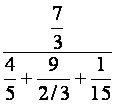
b)
(2/3)3
÷( (1 – 7/8)2 + ½ )
c)
(2*108)3
d)
(2*104)4
÷ (4*102)2
2. Simplify each expression below as much as possible; your answer should have positive exponents only.
a.
(a3b-2)-3(a2b-2)(a-2b-1)-1 b) (x-1 – y-1)-1(x-1y-1)-1
c) (x +y)-2(x +y)3(x2y3)-2
d)

3 Please simplify each of the following expressions as much as possible
a) 1252/3 b) 3-2 c)
45/2 d) 81-4/3 e)
(-1)5331 f) 31252/5
4.Given that 1 meter = 39 inches, what is the distance to the Sun in kilometers if the distance in miles is assumed to be 93 million?
Please show all steps leading to your answer and pay close attention to units.
5. Is it true in general that
a) (x y)n = xnyn ? (n a positive integer)
b) (x + y )n = xn + yn ?
c) 1/x + 1/y = 1/(x+ y)
if your answer to any of them is no, provide a counterexample.
Follow
this link for solutions to Problem Set #1
3. Expansions
A common problem is to expand something like (x + 2)(x+9) or x3(x+2)2 . This is the focus of this section, to be systematic and to get results.
For (x + 2)(x+9) you have the product of two parentheses. It is important to remember that: everything in the first parentheses must multiply everything in the second one, so we have
(x
+ 2)(x+9) = x*x + x*9 + 2*x + 2*9
= x2 + 11x +18
Problem
Set #2:
1. Using this, please expand (x + 4)*(x+10) with the result of x2 + 14x + 40
2. Please expand (x – 7)*(x – 1) and show the result is x2
– 8x + 7
3. Please expand (x – 9)*(x + 9) and show the result is x2
-81
4. What is the expansion of (x – 8)*(x+12) ?
5. What is the expansion of (x + 6)*(x – 9) ?
6. What is the expansion of (x + 4)2 ?
Part of learning and developing in mathematics is generalizing from your experiences. Suppose we look at the general problem
(x + a)*(x + b) (where a and b could be either positive or negative)
and the expansion x2 + (a + b)x + ab thus noting that the middle, or x term, has the sum of the constants in front of it while the last, or constant term, is the product of the constants from the parentheses. Remembering this helps later with factoring.
Back to one of our original problems, expanding x3(x+2)2 . This looks different. It is really two problems within one. First, remembering that a 2 for an exponent really meant that we are supposed to square what it is attached to, we have
x3(x + 2 )(x + 2)
Now arithmetic and algebra require that their operations (addition and multiplication) are binary, which means you can only work with two things or parentheses here, at a time. So we are going to ignore the x3 and just carry it along for a bit, thus thinking of only the blue terms below:
x3 ( (x + 2 )(x + 2) ) (
we also added a couple parentheses to keep
things clear.)
Now working inside the parentheses
we have an old problem which we multiply out to get x2 + 4x + 4, so things evolve to
x3 ( (x + 2 )(x + 2) ) =x3 ( x2 + 4x + 4 )
Now, using our earlier rule, that
everything outside the parentheses (x3
here) must multiply everything within it
(formally called the distributive
property), we have that this expression equals
x3*x2 + x3
*4x + x3
* 4
or x5 + 4x4 + 4x3 as
a final answer.
Problem: expand x2(x – 7)( x + 7)
Solution: x2
( (x-7)*(x + 7) ) = x2( x2 – 49)
= x4 – 49x2
Comment: this is not the only way to do these problems, but it works and is methodical. You could also multiply everything in the second parentheses by x2 and then expand the product of two parentheses:
x2(x
– 7)( x + 7) = (x3 – 7x2)(x+7) = x4
+ 7x3 -7x3 -49x2
= x4 – 49x2
Problem: expand
(x+2)3.
Solution: this looks different than what we have seen. It really isn’t. Remember the 3 is really shorthand for how many times we multiply, so
(x+2)3 =
(x+2)(x+2)(x+2)
Now we go back to what we know how to do and focus, say, on the last two parentheses (emphasized by blue):
(x+2)(x+2)(x+2) =
(x+2) ( (x+2)(x+2)
)
= (x + 2) ( x2 + 4x
+ 4 )
= x*x2 + x*4x
+ x*4 + 2*x2
+ 2*4x + 2 * 4
= x3
+ 6x2 + 12x + 8
where we remind the reader that in going from the second to third step, once again, everything in the first parentheses , x+2 , must multiply everything in the second parentheses, x2 + 4x + 4 , so there are a total of 2*3 or 6 terms to be accounted for. This one is a lot of work!! Imagine (x + 2)4 !
Comment: much of developing skill in mathematics is changing a new problem into a collection of problems you already know how to solve. True here!
Problem
Set #3 :
In each case expand
and collect like terms
a) x6(x2 + 1)2 b)
x(x – 9)(x + 1) c) x4 (x2-2)(x-1) d) (x
+ 1)3
e) x3(x – 9)(x+9)
Follow this
link to solutions to Problem Set #3
Expansions
with Pascal’s Triangle
A problem like expanding (x+2)4 can be done with the approaches we have shown so far. One way might be:
(x+2)4 = (x+2) (x+2) (x+2) (x+2) by definition of exponents
=( (x+2) (x+2) ) ( (x+2) (x+2) ) with a little organization
= ( x2 + 4x + 4) ( x2 + 4x + 4 ) working in the parentheses
at this point, you have to take a deep breath and multiply all 3 terms in the first
parentheses by all 3 in the second, so 9 terms, and then collect like terms and hope
you did not make any errors. The details are
=( x2 + 4x + 4) ( x2 + 4x + 4 )
= x2*x2
+ x2*4x+x2*4
+ 4x*x2 + 4x*4x
+ 4x*4 + 4*x2
+ 4*4x+4*4
=x4 +8x3
+24x2 + 32x + 16
A lot of work!!!
This type of expansion happens in Calculus I as well as Discrete Math and other courses. An easier way is by taking advantage of Pascal’s Triangle, which is
1
1 1
1 2 1
1 3 3 1
1 4 6 4 1
and in general is formed by the following rules:
a)
1’s at the
beginning and end of rows
b)
any other
number is the
sum of the two numbers immediately above it (right and left) (called Pascal’s Identity)
so we note that
each row has one more term than the one
above it
the triangle is symmetric about a
vertical line down the center
We refer to the top 1 as the 0th row, the next rown (1 1) as the 1st row , and so on and thus note further that
the nth row has n+1 terms in it
the second term in from the left or
right is n
Can you keep building the triangle? What is the next (5th) row? You should be able to show that it is 1 5 10 10 5 1.
What is the 6th row?
Note that between the 1s on the edges and the symmetry you only have a few numbers to compute at worst.
Comment: one should be able to compute the first 10 rows of Pascal’s Triangle in a couple of minutes.
OK… so we can construct it. What is it good for?? A lot of things, but here it is good for doing an expansion of the form
(x
+ a)n
where n is a positive integer. We have seen that this gets to be a lot of work and prone to error if n is 3 or 4. Using Pascal’s Triangle makes this much easier. Why? for the following reason:
the coefficients in the nth row of Pascal’s Triangle are
the coefficients in the
expansion of (x+a)n
We will try to illustrate that in what follows by examples.
(x+a)2 = (x + a)(x + a) = x2 + 2ax + a2 (note the coefficients are 1 2 1 )
(x + a)3 = (x + a)(x + a)(x+a) = x3 + 3ax2 + 3a2x + a3 (note 1 3 3 1)
(x+a)4 = (x + a)(x + a) (x + a)(x + a) = x4 + 4ax3 + 6a2x2 + 4a3x + a4 ( note 1 4 6 4 1)
These expansions can all be done by the methods shown earlier. But they can be done much more quickly using Pascal’s Triangle!
Now some details need mentioning. In expanding, for example, (x+a)3, note that if you look at each of the 4 terms in the expansion, the total of the exponents is always 3. This is no accident and is due to your cubing x + a.
If you look at each of the terms in (x+a)4 the sum of all exponents is 4. No accident.
Any term in the final result occurs due to multiplying 4 objects together that each came from an (x + a) component. Since the exponent of x as well as a is 1, the total should be 4.
This means, if you think about it, that there can be no a2x3 term in (x
+ a)4 nor can there be
any a3x6
term in (x+a)7.
Problem: expand (x + a)6 using Pascal’s Triangle
solution: first you need all terms whose exponents add to 6. So a skeleton of the answer is
x6 + __ ax5 + __ a2x4
+ __a3x3 + __a4x2 + __a5x + a6
where we need to fill in the blanks. So we have reduced the problem to finding 5 numbers. These come from the 6th row of Pascal’s Triangle.
The 6th row of Pascal’s Triangle is quickly found to be
1 6
15 20 15
6 1
and so the answer to our problem is
x6 + 6ax5 + 15a2x4 + 20a3x3
+ 15a4x2
+ 6 a5x + a6
and we happily note that this took very little work, especially compared to the old, “brute force” approach of just plain expanding it out!
For particular problems with a constant instead of the symbol for a, you just do what we did and as a very last step, substitute a in to your answer:
to find (x+ 5)4, we first expand (x + a)4 which is seen quickly to be
x4 + 4ax3
+ 6a2x2 +4a3x + a4
since the 4th
row of Pascal’s Triangle is 1
4 6 4 1
and then set a = 5, do a little arithmetic for 53 and 54 and get
x4 + 4*5x3
+ 6*52x2 +4*53x + 54
or x4
+ 20x3 + 150x2 +500x + 625
which is much quicker than working out (x+5)(x+5)(x+5)(x+5) as well as less likely to generate an error.
Problem
Set #4:
in each case, perform the expansion, and put your answer in
an organized form leading from highest exponent of x to lowest.
1. Please expand and simplify
a) (x+y)7
b) (x – 3y)5
c) (y + 2x)4
d) (-x – y)4
e) (a +5b)5
2. What is the coefficient of x13y5 in the expansion of (x+y)20? (think!)
3. Please simplify each of the following as much as possible.
a) [ (x + h)3 - x3]/h b) ( (x+
a)4 – x4 )/a
Follow this link
to solutions to Problem Set #4:
4. FACTORING
A reverse problem from expansions is factoring. In certain areas of Calculus I and III, an expression needs to be factored as much as possible, primarily to see the values of x for which it is equal to 0 (the two problems go hand in hand).
So we are given expressions such as
x2 – 3x – 21
x2 – 81
x4 – 25x2
x3 – 6x2
+ 11x -6
x2e-x
– e-x
x2 + 16
x4-81
and wish to factor them as much as possible.
What follows will illustrate some of the skills needed.
First, factor out any possible powers of x from all terms, if any are present:
x4 + 5x3
+ 6x2 = x2(x2 + 5x +
6)
Next focus on the remaining polynomial. It is 2nd degree or quadratic. Let’s look at quadratics in general. If they factor, then they factor into
(x + a)(x+ b)
which, if expanded back out, gives us x2 + (a+b)x + ab which provides some useful information:
- the coefficient of x is the sum
of the constants
- the last term is the product of
the constants we are after.
so in the current problem, a+b = 5 and ab = 6 leading us to conclude a=2 and b = 3.
Thus the factoring is
x2(x + 2)(x + 3)
and we are done. We note in passing that the function is
equal to 0 when x =0 or -2 or -3.
An important case is when a and b are the negatives of one another. An example would arise in the problem of factoring
x2
– 25
This says that the sum of the constants is 0 while their product is -25. So we would try + 5 and -5, or
(x +5)(x –
5)
which, if it is expanded, works fine. An expression like x2 -25 is usually referred to as “the difference of two squares”. Other examples along with their factorings are:
x2 - 36 = (x +6)(x -6)
x2 - 49 = (x +7)(x -7)
x2 - 1 =
(x +1)(x -1)
x2 - 81 = (x +9)(x -9)
as well as x4 – 81 = (x2 -9)(x2 + 9) which can, in turn, be factored even further into
(x + 3)(x -3)(x2 + 9)
while one of the form x2 + 25 cannot be factored. (The sign makes all the difference.)
Problem
Set #5:
1. Factor each quadratic below (there are no "duds" among them)
a) x2 + x -
56
b) x2 - 81
c) x2 – 6x - 91
d) x2 + 7x
e) x3 – 6x2
– 40x
2. Factor each below as much as possible. Your answers may be checked by expanding them and comparing to the original expression.
a) x2 – 5x - 24
b) x6 – 100x4
c) x2 + 7x + 10
d) x2 – 121
e) x2 -12x + 35
f) x2 + 16
g) x2 + 100x
h) 5x3 -125x
i) x4 – 625
j) 100 – 4x2
k) x4 + 25x2
Follow this link for solutions to
Problem Set #5
5. Logs and Exponentials
Many scientific quantities are quite large and, as a result, are written in scientific notation. The population of a country might be approximately 250 million, which could be written as 2.5x10⁸. Such numbers are usually approximations, and the details of the omitted places are not of much interest. In other words, to someone estimating the housing needs of the population does not really care whether the population is 251,628,000 or 249,020,111, only that it is near 250 million. What would interest such a person is if it were to increase by a factor of 4, for instance. This would change it from
2.5x 10⁸ to 1x 10⁹. The change would be big enough to effect the exponent. For such reasons, logarithms are used. They extract the exponent of a number. They are used in:
calculus
statistics
chemistry (for pH values)
geology (for the Richter scale)
engineering (for heat
flow measurements)
and electronics (for decibels).
First, a base is always used. In what follows, base 10 will be assumed. In other places, a base of e, for natural logs, may be used. The algebra is all the same no matter what base is employed.
Secondly, the (base 10) log of a number is its base 10 exponent, by definition. Thus the following examples are true:
log(100) = 2 because 102 = 100
log(1000) = 3 because
103 = 1000
log(1) = 0
because 100 = 1
log(.01) = -2 because
10-2 = 1/102 = 1/100 = .01
while other values require a calculator (familiarity with this operation is a good idea).
Notation: the symbols log and log10 both refer to base 10 logarithms while the symbol ln refers to natural logarithms, base e.
Properties of logs:
1) log(10x) = x (the log is the exponent; these are inverse operations)
2) 10log(x) = x ( these are inverse operations)
3)
log(AB) =
log(A) + log(B)
4)
log(A/B) =
log(A) – log(B)
Discussion:
Property 1 is the definition and Property 2 is saying the same thing.
To see why Property 3
is true, suppose A = 10x and B
= 10y. Then by definition, log(A) = the exponent = x. Similarly
log(B) = log(10y) = y.
Now A*B = 10x * 10y = 10x+y by properties of exponents (a key fact here)
so log(AB) = log(10x+y ) = x+y.
Therefore log(AB) =
log(A) + log(B) = x+y.
Historically, one of the reasons logs were used is because they reduced multiplication problems to addition problems (easier).
For an example, suppose we let A = 100 and B = 10,000. Then AB
= 1,000,000
and log(AB) = 6 = 2+4
= log(100) + log(10,000).
Property 4 is the same argument except it is based upon the fact that when you divide numbers to the same base you subtract exponents. For example,
10,000/100 = 104/102
= 104-2 = 102
Problem
Set #6:
In what follows, suppose that it is given that the following are true
log(2) = .3 log(3) = .48 log(5) = .7 log(7) = .85
Use these facts, if applicable, and properties of logs and
algebra to provide values for:
(no calculators!)
a) log(1000)
b) log(6)
c) log(9)
d) log(1/2)
e) log(7/5)
f) log(30)
g) log(81)
Next, use algebra and log properties to simplify each expression:
h) 10log(2)
i) 10-log(5)
j) 100log(3)
k) 1000log(2)
If the Richter scale is a logarithm of the energy associated with an earthquake, can you explain why a change of 1 in its value for one earthquake vs another is so significant?
Follow this link for solutions to
Problem Set #6
6. Series
Series are used in Calculus II and also Calculus III. They are not bad to work with if you have seen them before, confusing if you haven’t.
First of all they are shorthand notation for addition. If you remember nothing else about them, that fact alone is valuable.
Suppose we wanted to add up the squares of the first 100 integers. One way to write the problem out would be to write
12 + 22 + 32 + 42 + . . . + 1002 (the three dots, . . . , can be taken as meaning “everything in between”).
Summation notation allows a more concise form:
12 + 22
+ 32 + 42 + . . . + 1002 = 
There are 5 things to remember the significance of on the right side:
 which means
“addition”
which means
“addition”
i the index, which takes on values from 1 to 100 in increments of one
1 the starting point for i
100 the ending point for i
i2 the quantity being added up at each step
Using this, we can then interpret the following symbols:
 the sum of the
squares of the first 50 integers
the sum of the
squares of the first 50 integers

the sum of the cubes of the integers from 3 to 10 or
33 + 43 + 53 + 63 + 73 + 83 + 93 + 103 (or 3016 if you actually add them)
 the sum of the
first 10 powers of 2 or
the sum of the
first 10 powers of 2 or
21 + 22 + 23 + . . . + 210
(called a geometric series)
Comment: you can use any variable for the index as it takes on specific values. Thus

Problems: write out each series below
a)  b)
b)  c)
c)  d)
d)  e)
e) 
Comment: if you are
a computer programmer, this relates directly to for loops as an example. Problem a),
above, might translate into sum:=0; for i from 1 to 4 do
sum:=sum+i^4;
Arithmetic Series
A simple problem might be to add up the first 70 integers. One could simply do this but it would take a long time and be quite inefficient in terms of effort expended. Instead we will look for a formula that gets it done quickly and is the same no matter how many integers are being added.
The great mathematician Karl Gauss (1777-1855), while a
schoolboy in
first he wrote the series down forwards and backwards, carefully aligned
1 + 2
+ 3 +
4 + 5 + . . . . . + 69 + 70
70 + 69 + 68 +
67 + 66 + + 2 + 1
then he noted that if you added pairs of numbers vertically, you always got the same thing, 71. Further this happens 70 times
1 + 2
+ 3 +
4 + 5 + . . . . . + 69 + 70
70 + 69 + 68 +
67 +
66 + + 2 + 1
71 71
71 71 71 71 71
so the total of all these numbers must be 70(71). The only problem here is that everything
got counted twice so the answer is
too big by a factor of 2 and is
therefore 70(71)/2 = 35*71 = 2485 after dividing by 2.
In general, by the same thinking, the sum of the first n integers is seen to be
 Gauss’ Formula for Arithmetic Series
Thus we can quickly add up the first 1000 integers as (1000)(1001)/2
= 500(1001) = 500500
Problem: add up the first 200 even integers
Solution:
we begin with 2 + 4 + 6 + 8 + … + 400
since they are all even we can factor out a 2: 2(1 +
2 + 3 + 4 . . . 200)
so we have twice the total of the first 200 integers or

Problem: find the total 3+4+5+6+ . . . + 300
Solution: this looks like an arithmetic series except it is missing 1 and 2.
We know that
1+2+ 3+4+5+6+
. . . + 300 = (300)(301)/2
which will be 3 bigger than what we want as it includes 1 and 2, so the answer to our problem is therefore
(300)(301)/2 - (1 + 2) =
(150(301) – 3 =
45150 – 3 = 45147
In general, if your series does not start at 1, use the formula anyway and subtract off what you do not need (1 + 2 here).
Geometric Series
An old problem in math is to ask students to ponder the following:
You are 2 yards from a wall. You take a step 1 yard long towards the wall, then another half as long, then another half as long as that, and so on. Will you ever reach the wall?
Arithmetically this amounts to adding up the following numbers
1 + ½ + ¼ + 1/8 + 1/16 + . . . .1/1024
or
1 + (½) + (½)2 + (½)3
+ (½)4 + . . . .+( ½ )10
in other words, you are adding up the first 11 powers of (1/2). (1 is also a power of ½, the 0th power)
We would like a formula that provides a total of some kind. This is far to much work to do the long way!
This is an example of a geometric series as we are adding up powers of a constant (1/2) In summation notation we have

while the general
form may be  where r is the constant.
Along with arithmetic series, this is an example of a series that can actually be summed, meaning there is a formula for quickly adding up as many terms as you like. Such series are rare.
Key
Formula for Geometric Series:

Applying this to the problem we started with, r= ½, n=11. The formula gives us

With a little arithmetic, the fraction on the right is 2(1 – 1/2048) = 2 – 1/1024 = 2047/1024 (which we note is very close to 2 but a little less than 2 !! We did not quite make it to the wall after 11 steps).
Example: add
up the first 40 powers of 3.
Solution: in series form this is

because n = 40 and r=3. The Key Formula above sums this easily as

Example: sum the following series
4+8+16+32+64+ . . . + 512
Solution: This is a geometric series of the following
form  because 29 =512
Using the Key Formula we can sum
 as
as 
the only trouble is that this series starts with 1 +2 while ours began with 4.
So we have to subtract off 3
from the total of 1023 given by the Key Formula to fit it to our situation.
Thus the answer to our problem is 1020.
Example: sum the
series 1 – 4 + 16 -64 + 256 – 1024 + 4096 using the Key Formula
Solution: this is a geometric series where r =
-4 and n = 7.
The minus signs result from taking odd powers of -4. This is also called an alternating series.
The Key Formula still applies and gives us

Proof of the Key Formula for Geometric Series is about as easy as the proof of Gauss’ Formula for Arithmetic Series
start with 1 + r + r2 + r3 + . . . + rn-1 , the sum of the first n powers of r.
Now multiply it by (1-r):
(1 + r + r2 + r3 + .
. . + rn-1)(1 - r)
to do this, take note of the fact that everything in the left parentheses will get multiplied by 1 and also by –r.
Multiplying by 1 just gives us the series back again while multiplying by –r puts a minus sign in and raises all exponents by 1 (think about this…) So we have
1 + r + r2 + r3 + . . . + rn-1 - r – r2
–r3 – r4 . . . –rn-1 - rn
Now a lot of things cancel out!! In fact everything cancels out except the first and last terms or 1 and –rn. Thus we have
(1 + r + r2 + r3 + .
. . + rn-1)(1 - r) = 1 - rn
so if we divide both sides by 1-r we have
(1 + r + r2 + r3 + . . . + rn-1) = (1
– rn)/(1-r)
which is the Key Formula.
Example:
determine (1+ 5)+ ( 2+25+) + (3+125) + . . . + (15+ 515) using series techniques
solution
in series form this is

This looks kind of confusing! On one hand it looks like an Arithmetic series but on the other hand it looks like Geometric. What to do??
The key to the dilemma is to rearrange things
(1+ 5)+( 2+25+) + (3+125) +. . .+ (15+ 515) = (1 + 2 + 3 + …+15) +(5+25 +125 + …515)
which we can do because addition is a commutative operation which means order does not matter. Now the blue portion is Arithmetic and the black portion Geometric and we can attack them separately as earlier:
1
+ 2 + 3 + …15 = (15)(16)/2 = 120 by
Gauss’ Formula
while the black portion is the sum of the first 16 powers of 5, less one, or

by the Key Formula for Geometric Series.
The sum of the entire original series is
120
+ or, perhaps
better, 119 + (516 -1)/4
Comment: this illustrates an important technique in working with series – that you can sometimes split a problem up into two parts and solve each one independently. This is because series are linear. This turns out to have implications in calculus, that integrals are linear and some problems can be split up and attacked piecemeal.
The same thinking applies in
other area of math and engineering: take
a complex problem, break it down into simpler problems and solve each simpler
problem. Build the answer to the original problem with the simpler solutions.
Problem Simplify (6 +
6/2 + 6/4 + 6/8 + 6/ 16 + … + 6/1024)
solution: This looks like an earlier series but for the 6’s all over the place. Note that we can factor out the 6
6(1 + ½ + ¼ + 1/8 + … + 1/1024)
and then treat what is inside the parentheses as a Geometric Series

which is then summed by the Key Formula for Geometric Series to be
 or 12( 1
– 1/2047)
or 12( 1
– 1/2047)
The point here is that you can factor out a constant and carry it along provided it multiplies all terms in the series. This is a second implication of the fact that series are linear – the ability to factor constants out.
Problem
Set #7:
In each case provide one expression for the series given. Do not
oversimplify.
1.Please sum the following expressions:
a)
3 + 6 + 9 +
12 + 15 + . . . + 300
b)
1 + 1/3 +
1/9 + 1/27 + . . . + 1/2187
c)
5 + 6 + 7 + 8 + … + 80
d)
1/5 + 1/25 +
1/125 + 1/625 + 1/3125 + 1/15625
e)
3 + 3/2 + 3/4 + 3/8 + 3/16 + 3/32 + 3/64 + 3/128
+ 3/256 + 3/512 + 3/1024
2. Please sum the following series:
a) 1 + 1/3 + 1/9 + . . . + 1/729 b) 1 – 1/2 + 1/4 -1/8 + 1/16 . . . + 1/1024
c) 5 + 5/2 + 5/4 + . . . + 5/256 d) 1/25 + 1/125 + 1/625 + . . . + 1/78125
f)
6 + 8 + 10 +
. . . + 100
3. Consider the following series:

- write out the first three terms of the series and also the last two
- see if you can sum the series
4. Let's look at the odd positive integers and add them up
1 + 3 + 5 + 7 + . . . +33 for example
a) can you find a method for adding up the first 17 odd numbers? (other than simply adding them one by one)
b) can you extend your method and find a formula for the sum of the first n odd integers?
5. A very hard ball is dropped from a height of 100 feet. It strikes the ground and bounces back up, each time reaching a height of 3/4 the height of the previous bounce. It bounces 12 times before coming to rest. What is the total distance it traveled? What does this have to do with series??